
The Modern CAMO: Managing Airworthiness Across Systems, Records and Operations
Aircraft airworthiness is established through design, certification and maintenance, but maintaining that status throughout years of operation requires something broader: continuous control of the aircraft’s maintenance requirements, configuration, technical records, regulatory obligations and engineering decisions.
This is the role of the Continuing Airworthiness Management Organisation, or CAMO.
For an airline, aircraft owner or operator, continuing airworthiness is not a periodic check carried out before an audit or an Airworthiness Review. Every flight adds utilisation. Every maintenance event changes the aircraft history. Components are installed and removed. Defects are raised and rectified. Airworthiness Directives are issued. OEM publications are revised. Modifications alter aircraft configuration, while maintenance programme requirements continue to evolve.
CAMO provides the organisational framework that keeps those activities under control and ensures that the current airworthiness status of the aircraft can be understood and demonstrated.
Under the European regulatory framework, Part-CAMO sits within Regulation (EU) No 1321/2014. For commercial air transport under an AOC, continuing airworthiness must be managed by an approved Part-CAMO organisation.
The regulatory definition, however, is only the starting point. In daily operations, CAMO sits at the intersection of Engineering, Maintenance Planning, Technical Records, Reliability, Flight Operations, contracted maintenance organisations, OEM information and the aircraft itself. Understanding CAMO therefore means understanding how all of those elements remain aligned throughout the operational life of an aircraft.
CAMO in Aviation and the Role of Continuing Airworthiness Management
A CAMO is an organisation approved to manage the continuing airworthiness of aircraft within the scope of its approval. Its role is fundamentally different from simply performing maintenance.
A maintenance organisation carries out maintenance tasks on the aircraft or components. CAMO determines and controls the continuing airworthiness requirements around that work: what maintenance is required, when it needs to be performed, how regulatory and engineering requirements apply, and whether the resulting aircraft status remains properly documented.
EASA guidance describes this responsibility very directly: the CAMO should determine what maintenance is required, when it must be performed, by whom and to what standard to ensure the aircraft's continuing airworthiness. A CAMO managing an aircraft also remains responsible for the airworthy condition of that aircraft, even where maintenance is contracted to an approved maintenance organisation.
This makes CAMO an ongoing management and control function. In practice, it connects four fundamental questions:
What is the current aircraft status?
Aircraft configuration, utilisation, components, defects and maintenance history need to represent the aircraft accurately.
What needs to happen next?
Maintenance requirements, ADs, life limits, inspections and programme tasks need to be identified and controlled.
Has the required work been completed correctly?
Maintenance accomplishment and supporting records need to return into the continuing airworthiness record system.
Can the organisation demonstrate that status?
The technical basis, records and compliance evidence need to remain traceable when Engineering, management, an authority, lessor or auditor requires them. That cycle continues throughout the operating life of the aircraft.
Core CAMO Responsibilities
Part-CAMO responsibilities cover a much wider operating environment than a single compliance checklist.
Under CAMO.A.315, an approved organisation must manage continuing airworthiness in accordance with the applicable Part-M or Part-ML requirements. EASA also expects CAMOs to maintain adequate knowledge of aircraft design information and configuration, including ADs, airworthiness limitations, modifications, repairs, equipment and required and accomplished maintenance. In operational terms, the core responsibilities normally include the following areas:
Aircraft Maintenance Programme Management
The Aircraft Maintenance Programme, or AMP, defines the maintenance required to keep the aircraft airworthy. CAMO is responsible for developing and controlling the applicable programme for aircraft under its management, including the associated reliability programme where required. The programme needs to reflect mandatory continuing airworthiness information, applicable design information, aircraft configuration and operating experience.
This is not a static document. OEM recommendations change. Maintenance Review Board information may be revised. Operational experience can reveal the need for programme changes, while aircraft modifications may introduce new requirements.
Maintaining the AMP therefore requires continuous alignment between technical publications, regulatory requirements, fleet experience and the actual configuration of the aircraft.
Airworthiness Directives and Mandatory Requirements
Airworthiness Directives are another central CAMO responsibility. Receiving an AD is only the first step. Engineering must determine whether it applies to the aircraft, engine, APU or component concerned, identify the required action, control the applicable compliance limits and retain evidence showing how the requirement was addressed.
Applicability may depend on configuration, serial number, modification status or installed components. This makes AD control closely dependent on the quality of the underlying aircraft and component information.
The same principle extends to other mandatory continuing airworthiness requirements. A compliance status only remains meaningful when the organisation can trace the requirement to the affected asset, the engineering assessment and the action that followed.
Service Bulletins and Non-Mandatory Technical Information
Service Bulletins require a different form of engineering assessment because they are not automatically mandatory in every situation.
For complex motor-powered aircraft and aircraft used by relevant air carriers, EASA requires CAMOs to establish procedures for assessing non-mandatory modifications and inspections. The evaluation can consider aircraft configuration, operating environment, safety objectives, reliability improvement and maintenance programme effectiveness.
The practical CAMO question therefore becomes: Does this recommendation apply to our fleet, and should we incorporate it? That assessment requires access to current OEM information, reliable aircraft configuration and a traceable engineering decision.
Aircraft Configuration Control
Many continuing airworthiness decisions depend directly on configuration. A requirement may apply only to a particular aircraft standard, modification status, installed component or part number. A historical applicability decision that was correct last year may need to be reconsidered after a modification or component change.
CAMO therefore needs a sufficiently accurate representation of the aircraft configuration to support technical assessments. EASA guidance specifically expects CAMOs to have adequate knowledge of type specification, customer options, ADs, airworthiness limitations, modifications, repairs and installed operational and emergency equipment.
Configuration control is consequently much more than an aircraft master-data exercise. It provides the technical context behind maintenance and compliance decisions.
Continuing Airworthiness Records
The aircraft's continuing airworthiness records preserve the operational history behind its current status. These records can include maintenance accomplishment, component history, utilisation, AD status, modifications and repairs, life-limited parts and other information needed to demonstrate compliance and plan future maintenance.
Their value depends on more than existence. Records need to remain retrievable, consistent and connected to the aircraft status they represent. As an aircraft moves through maintenance organisations, systems, operators and years of service, maintaining that continuity becomes increasingly important. A record without its operational context may still exist, but additional engineering work is required before it can support a decision confidently.
Defect and Technical Status Control
CAMO also depends on a current understanding of aircraft defects and technical status.
Defects can affect planning, reliability, MEL management and follow-up engineering activity. Repetitive or recurring defects may also indicate patterns that need further reliability investigation.
This creates a close relationship between day-to-day technical operations and longer-term continuing airworthiness management. The information recorded during line operations today becomes part of the engineering history used for future planning and analysis.
Reliability Programme Management
For applicable aircraft and maintenance programmes, reliability analysis forms another important part of the CAMO environment.
Reliability programmes help organisations evaluate whether the maintenance programme continues to be effective and identify areas where engineering attention may be required. EASA's CAME framework explicitly includes both reliability programmes and analysis of maintenance programme effectiveness within CAMO procedures.
Reliability therefore sits downstream of the same operational information used elsewhere by CAMO: defects, component removals, utilisation, maintenance accomplishment and configuration.
Where that history is complete and consistent, engineers can spend more time investigating fleet performance. Where it is fragmented, part of each analysis cycle is spent preparing the information first.
CAMO, Part-145, MRO and CAO: Different Roles in Aircraft Airworthiness
Several aviation terms are frequently used together even though they refer to different responsibilities.
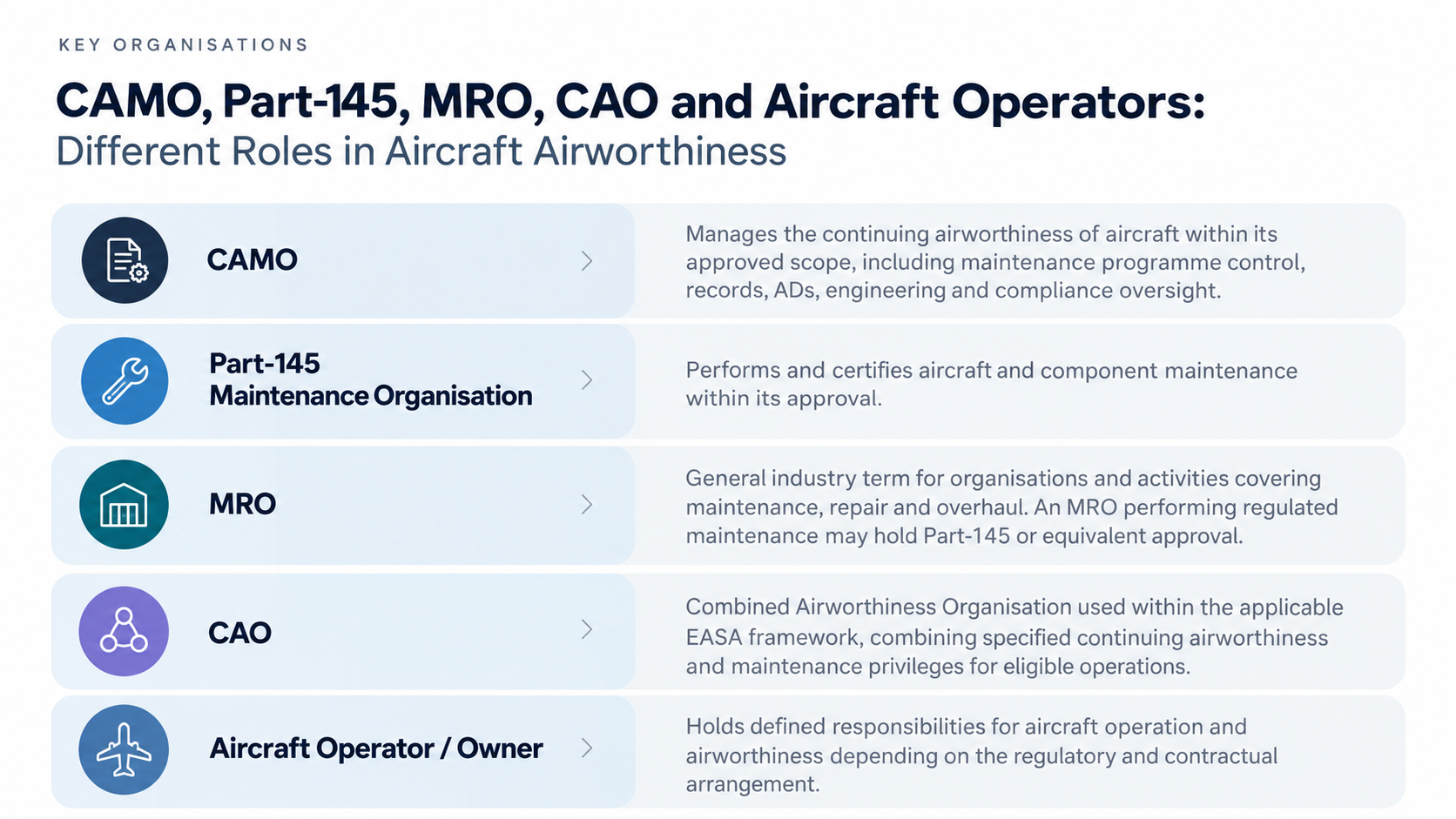
The most important distinction is between managing maintenance requirements and performing maintenance.
A CAMO may contract maintenance to a Part-145 organisation, but the contract does not remove the CAMO's continuing airworthiness management responsibility. EASA guidance requires clear allocation of responsibilities and permits CAMO oversight of contracted maintenance to verify that its airworthiness responsibilities are being fulfilled.
In simple operational terms:
CAMO controls what needs to be maintained and the continuing airworthiness status.
Part-145 performs and certifies the maintenance within its approved scope.
The interface between them is therefore critical. Work orders, maintenance data, defect information, accomplishment records and technical findings must move between organisations without losing the context required by either side.
The CAMO Operating Environment Extends Beyond a Single System
Modern CAMO operations rarely take place inside one software platform.
A core M&E system such as AMOS, TRAX, Veryon, OASES or another maintenance platform may act as the primary system of record, but CAMO information is also created and consumed elsewhere.
A typical operating environment may include:
an M&E or MRO system;
an electronic technical log;
Technical Records systems;
OEM portals and technical publications;
regulatory AD sources;
reliability and analytics environments;
flight operations and utilisation systems;
engine or aircraft health-monitoring platforms;
contracted MRO systems;
locally maintained spreadsheets or specialist tools.
Each contributes part of the continuing airworthiness picture.
The operational challenge is keeping those sources aligned as the aircraft changes.
A utilisation value affects maintenance planning. A component replacement changes aircraft configuration. A new configuration can affect AD applicability. Maintenance accomplishment changes compliance status. An OEM revision may affect the technical basis behind an existing process.
CAMO therefore depends on the continuity of information between systems as much as it depends on individual system functionality.
This is also where a technically strong M&E system can still be surrounded by considerable manual work. The data exists, but engineers may need to validate, reconcile or interpret information from adjacent systems before relying on the operational picture.
CAMO Software and the Digital Continuing Airworthiness Environment
CAMO software is often described in terms of functions: maintenance planning, AD/SB tracking, records management, reliability reporting, and dashboards. Those functions matter, but software alone does not define an effective CAMO environment.
The stronger question is whether the system environment allows CAMO to maintain the relationships between:
aircraft status → maintenance requirement → engineering decision → maintenance execution → supporting evidence.
A digital CAMO environment should help teams maintain those relationships consistently over time. This typically requires several capabilities:
Maintenance Planning and Forecasting
CAMO teams need accurate utilisation, aircraft status and maintenance requirements to forecast upcoming tasks and maintenance events. Where utilisation or configuration information is inconsistent, planning teams need additional validation before the forecast can be relied upon.
AD and SB Management
Digital workflows can support retrieval, assessment, applicability, compliance tracking and supporting evidence. The objective is not to automate the engineering authority behind an applicability or accomplishment decision. It is to make the information and workflow around that decision more controlled and traceable.
Technical Records and Traceability
Digital records should make aircraft history easier to retrieve and verify. This becomes particularly important during audits, Airworthiness Reviews, aircraft transactions and lease returns, when historic information needs to support the current aircraft position.
Aircraft and Component Configuration
Component position, serial number, installation history and modification status provide essential context for continuing airworthiness decisions. Configuration information therefore needs to remain aligned with the maintenance events that change it.
Reliability and Engineering Analytics
Reliability reporting allows CAMO and Engineering teams to monitor recurring defects, component behaviour, technical dispatch performance and maintenance programme effectiveness. Analytics becomes more useful as the underlying maintenance history becomes easier to trust and investigate.
System Integration
The more specialised systems an organisation uses, the more important controlled data exchange becomes. Manual transfer between eTechLogs, M&E systems, OEM environments, MROs and analytics platforms introduces additional opportunities for discrepancies and creates recurring reconciliation work.
The objective of integration should therefore extend beyond simply moving data from one system to another. The data also needs to retain the structure and context required by the receiving engineering process.
Airworthiness Reviews and the Airworthiness Review Certificate
An Airworthiness Review is related to CAMO activity but should not be confused with everyday continuing airworthiness management.
Where the CAMO holds the appropriate privilege, authorised Airworthiness Review Staff may perform airworthiness reviews in accordance with the applicable Part-M or Part-ML provisions. EASA establishes specific experience and qualification requirements for these staff.
The review examines whether the documented status of the aircraft supports its continuing airworthiness. EASA guidance for a full documented review includes categories such as:
continuing airworthiness records;
aircraft technical log;
deferred defects and MEL status;
aircraft flight manual and configuration;
aircraft maintenance programme;
maintenance data and relevant work packages;
AD status;
modification and SB status;
life-limited parts and time-controlled components;
relevant release documentation;
mass and balance information;
aircraft, engine and propeller type-certification information.
This breadth explains why Airworthiness Reviews are often where weaknesses in everyday information management become visible. When aircraft status, records and engineering decisions remain consistently maintained throughout normal operations, the review becomes primarily an exercise in demonstrating an already-controlled position. Where they do not, considerable work may be required to reconstruct that position.
CAMO Audit Readiness Begins During Daily Operations
The same principle applies to regulatory and internal audits. Audit preparation often appears to be a temporary workload that begins when an inspection is scheduled. In practice, almost all the evidence requested during an audit has already been created through everyday CAMO processes.
The CAME itself illustrates how broad that evidence base is. EASA's acceptable CAME structure includes records control, AMP management, AD accomplishment, maintenance programme effectiveness, repairs and modifications, defects, reliability programmes, safety risk management, compliance monitoring and contracted-maintenance oversight.
This means audit readiness is largely determined before the audit starts. Where technical records, configuration, maintenance status and compliance evidence remain aligned, CAMO can retrieve and demonstrate the required information efficiently. Where the information is distributed across systems or depends on locally understood workarounds, audit preparation becomes a reconciliation exercise.
For a deeper examination of this issue, read CAMO Audit Readiness: How to Prepare for Airworthiness Audits.
The Continuing Airworthiness Management Exposition (CAME)
The Continuing Airworthiness Management Exposition, or CAME, describes how the CAMO is organised and how it performs the activities covered by its approval. It is much more than an administrative manual. The CAME establishes the organisation's procedures for areas such as:
management responsibilities;
continuing airworthiness records;
AMP development and amendment;
AD control;
engineering and reliability activities;
safety risk management;
compliance monitoring;
contracted maintenance;
Airworthiness Review procedures where applicable;
personnel competency;
occurrence reporting.
EASA requires the relevant CAME information to be provided directly or by reference and expects personnel to be familiar with the sections relevant to their duties. The CAME therefore connects regulatory requirements to repeatable organisational processes. An effective CAMO needs both: the documented procedure and an operating environment capable of executing that procedure consistently.

Part-CAMO Approval and Organisational Oversight
Part-CAMO approval is granted by the applicable competent authority. The organisation needs to demonstrate that its management system, procedures, personnel and resources are appropriate for the scope of continuing airworthiness activities it intends to manage.
The exact administrative process varies between national authorities. Finland’s Traficom provides one practical example: applicants submit information describing the organisation and requested scope, together with relevant documentation such as the CAME and applicable maintenance programmes. The authority then reviews the organisation, nominated personnel and procedures before approval is granted.
National authorities also continue to oversee approved organisations after approval. Switzerland’s Federal Office of Civil Aviation (FOCA), for example, describes ongoing inspections and audits of CAMO and CAO organisations as part of its oversight responsibilities, with identified deficiencies requiring corrective action where regulatory requirements are no longer met.
The important point is that Part-CAMO approval is not a one-time administrative exercise. The organisation must continue to demonstrate that its procedures, personnel and management system remain compliant with the applicable requirements throughout the life of the approval.
Common Operational Challenges for CAMO Teams
The regulatory responsibilities of a CAMO are well defined. The operational difficulty often lies in executing them consistently across a complex aircraft-data environment. Several challenges appear repeatedly:
Fragmented Operational Information
Aircraft configuration may reside in the M&E system while OEM information comes from separate portals, utilisation arrives from operational systems and supporting evidence sits within Technical Records. The information may all exist without providing CAMO with one coherent operational picture.
Manual Reconciliation
Differences between systems create additional checking. Engineers compare utilisation, component history, AD status or accomplishment information before they can establish which source reflects the current aircraft position.
Changing OEM Information
AMMs, IPCs, MPDs and Service Bulletins continue to evolve. CAMO and Engineering need to understand what changed, whether it applies and whether the latest approved position is reflected in downstream processes.
Aircraft Configuration Complexity
Every modification, component replacement or aircraft transition can change the configuration against which maintenance and compliance requirements are assessed. Maintaining that context over time requires disciplined configuration control.
Audit and Airworthiness Review Preparation
Where daily information management is fragmented, authority reviews and audits can expose years of accumulated inconsistencies at once. The team then spends time reconstructing the evidence trail rather than simply demonstrating it.
Dependence on Individual Knowledge
Experienced CAMO engineers often know which reports require additional checks, where historic records are kept and which local workarounds need to be considered. That expertise is valuable, but excessive dependence on individual knowledge creates organisational fragility. The stronger operating model preserves more of that context within the process and the data itself.

Continuing Airworthiness Depends on Information Continuity
This leads to an important distinction. Regulation defines what CAMO must control. Software provides tools for managing those activities. Day-to-day continuing airworthiness depends on whether the operational information behind those controls remains usable as the aircraft changes.
A maintenance requirement assessed today may depend on a modification completed years earlier. An AD applicability decision may depend on the serial number of a component installed last month. A reliability trend may depend on defect and utilisation history accumulated over hundreds of sectors. An Airworthiness Review may need to reconstruct all of those relationships at once.
That is why continuing airworthiness increasingly becomes an information-continuity problem as well as a compliance discipline.
At EXSYN, we describe this underlying capability as Aviation Data Continuity: maintaining the relationship between aircraft data, engineering context and supporting evidence across systems, organisations and lifecycle events.
For CAMO teams, the practical objective is straightforward: aircraft configuration, maintenance history, current technical information and compliance evidence should remain sufficiently aligned that engineers can establish the aircraft status without repeatedly reconstructing it.
From Regulatory Compliance to Compliance Confidence
Compliance remains the regulatory requirement. A more mature CAMO operating environment allows the organisation to demonstrate compliance efficiently because the underlying information is already current, traceable, and connected.
We describe this as Compliance Confidence.
It means that when CAMO needs to answer questions such as:
Is this AD applicable?
Is the current AMP reflecting the latest applicable requirements?
Does the documented configuration match the aircraft?
Has the required maintenance been completed?
Which technical information supported this decision?
Can the supporting record be retrieved?
Are the aircraft records ready for an Airworthiness Review or authority inspection?
The answer does not begin with several days of information reconstruction.
This also creates the foundation for the capabilities that come after compliance: stronger Reliability Intelligence, earlier identification of developing operational issues and, eventually, more advanced predictive and AI-assisted decision support.
Supporting the CAMO Environment with EXSYN
EXSYN works around the existing M&E environment rather than asking CAMO teams to replace the systems that already manage their core maintenance processes.
Different applications support different parts of the continuing airworthiness workflow:
M&E Consistency Checks help identify inconsistencies in operational and maintenance information so they can be investigated earlier.
OEM Library and engineering data validation support control of changing technical information and revision workflows.
AD Integration supports retrieval and preparation of Airworthiness Directive information while leaving applicability and engineering decisions under customer authority.
Airworthiness Reviews & Checks support systematic review of the information required to assess the continuing airworthiness position.
Data Integration connects information between the M&E system and the other environments that contribute to Engineering and CAMO processes.
Reliability Analysis extends the same operational history into fleet-performance and recurring-issue investigation.
The objective across these capabilities is consistent: preserve the operational context behind continuing airworthiness decisions while reducing the amount of recurring validation and reconciliation surrounding the core M&E system.
For organisations using AMOS or another established M&E platform, this allows the system of record to remain central while strengthening the information and processes around it.
The Future of CAMO Is More Connected, Not Less Controlled
Continuing airworthiness management is becoming increasingly digital. Electronic technical logs, connected aircraft data, automated regulatory feeds, OEM data exchange, reliability analytics and AI-assisted engineering tools are increasing the amount of information available to CAMO teams.
The role of CAMO does not become less important as those technologies mature. It becomes more dependent on the quality of the information flowing through them. More automation requires clearer data ownership. More integration requires stronger configuration control. More analytics requires reliable historical information. AI-assisted decision support requires engineers to understand the context behind the information presented to them.
The regulatory responsibilities remain anchored in continuing airworthiness. The operating environment around those responsibilities continues to evolve. For CAMO organisations, the opportunity is therefore to build a digital environment where technology reduces repetitive information work while engineering authority, traceability and regulatory control remain clear.
That is ultimately what a mature continuing airworthiness environment should provide: not simply more data or more systems, but a consistently understood aircraft status throughout its operational life.
Frequently Asked Questions About CAMO and Continuing Airworthiness
-
CAMO stands for Continuing Airworthiness Management Organisation. Within the EASA framework, a Part-CAMO-approved organisation manages the continuing airworthiness of aircraft within its approved scope, including activities such as maintenance programme control, continuing airworthiness records, AD management and coordination of required maintenance.
-
Not necessarily. CAMO manages the continuing airworthiness requirements and may contract maintenance to an appropriately approved maintenance organisation such as a Part-145 organisation. The CAMO remains responsible for the continuing airworthiness management of the aircraft under its management.
-
CAMO refers to the continuing airworthiness management function and regulatory approval. MRO is a broader industry term covering maintenance, repair and overhaul activities and organisations. A maintenance organisation may physically perform maintenance while CAMO manages the requirements, status and continuing airworthiness responsibilities around that maintenance.
-
Part-CAMO governs continuing airworthiness management. Part-145 governs approved maintenance organisations that perform and certify maintenance within their scope of approval. The two often work closely together but have different regulatory responsibilities.
-
CAMO responsibilities can include Aircraft Maintenance Programme control, continuing airworthiness records, AD management, modification and repair status, defect and reliability activities, aircraft configuration, management of contracted maintenance and Airworthiness Reviews where the organisation holds the appropriate privileges.
-
CAME stands for Continuing Airworthiness Management Exposition. It describes the CAMO's organisation, management system and procedures for carrying out the continuing airworthiness activities covered by its approval.
-
An Airworthiness Review assesses the aircraft and its documented continuing airworthiness status. Where a CAMO holds the appropriate privilege, authorised Airworthiness Review Staff can perform the review under the applicable regulatory requirements.
-
The Aircraft Maintenance Programme defines the maintenance requirements applicable to the aircraft, including relevant intervals and tasks. CAMO is responsible for developing and controlling the applicable programme for aircraft under its management in accordance with the regulatory framework.
-
Within the EASA framework, commercial air transport operations under an AOC require the responsible continuing airworthiness organisation to be an approved Part-CAMO.
-
CAMO organisations commonly use an M&E/MRO platform such as AMOS, TRAX, Veryon, OASES or another approved operational environment together with technical-records systems, eTechLogs, OEM information sources, regulatory databases and analytics tools. The exact software environment depends on the operator and fleet; the regulatory requirement concerns control of the continuing airworthiness process rather than the use of one specific software product.