
The EXSYN Operational Confidence Journey
No two airlines follow the same path towards digital transformation. Operational priorities are shaped by fleet size, organisational structure, regulatory requirements and the maturity of existing engineering processes. Some organisations begin by strengthening technical records ahead of an aircraft transition, while others focus on improving compliance, engineering reporting or reliability analysis. Increasingly, many are also preparing for predictive maintenance, operational intelligence and AI-assisted engineering. Although the priorities differ, the objective remains the same: enabling engineering teams to make operational decisions with greater confidence.
Operational confidence is rarely achieved through a single project or technology investment. It develops over time as operational information becomes more reliable, connected and accessible throughout the aircraft lifecycle. At EXSYN, we describe this progression as the Operational Confidence Journey—a framework that helps engineering organisations understand how operational capabilities evolve and identify the next practical step towards more confident decision-making.
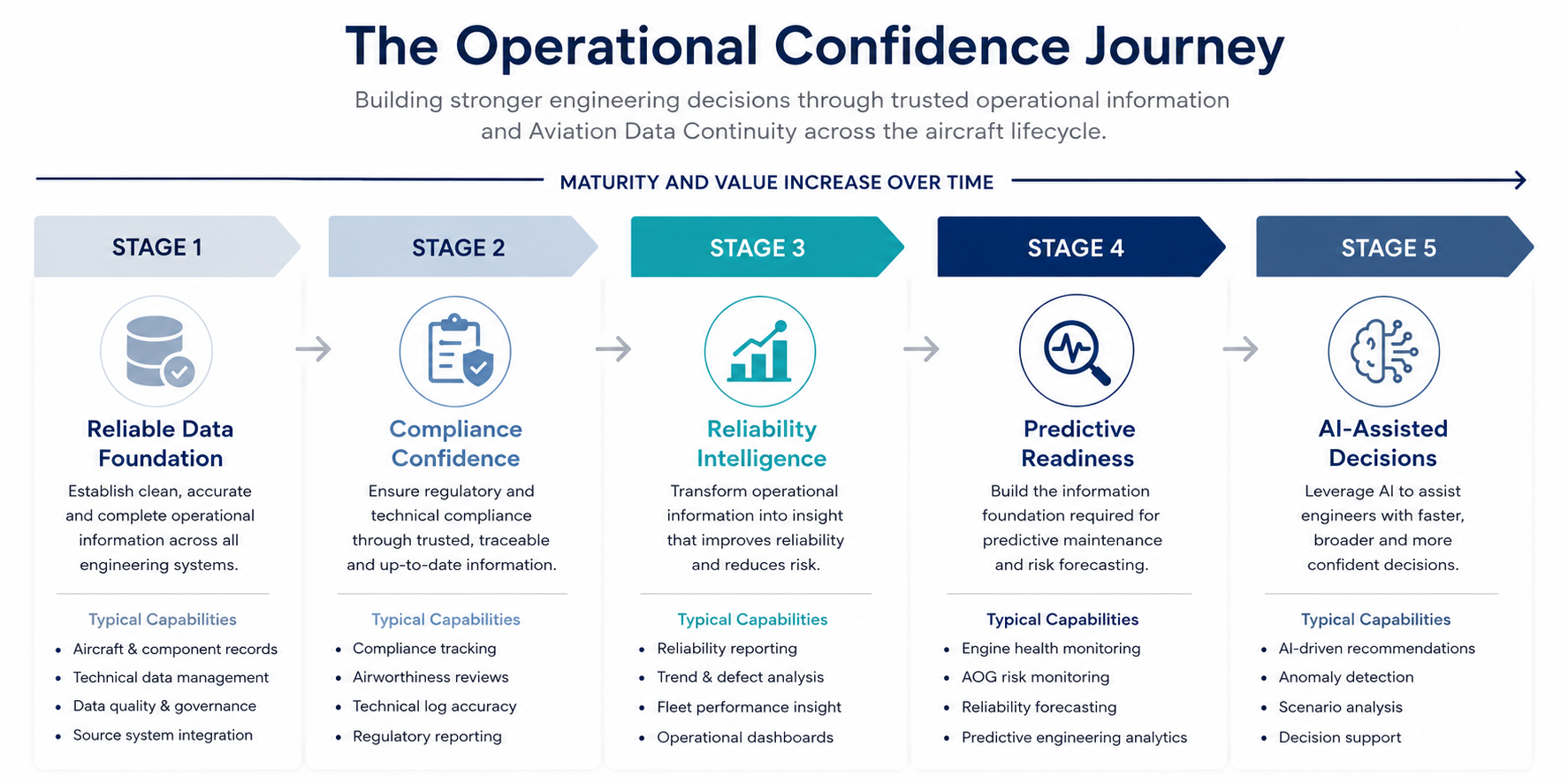
Stage 1 — Reliable Data Foundation
Every engineering decision relies on operational information. When maintenance records are incomplete, aircraft configuration is inconsistent or technical records cannot be readily verified, the impact extends far beyond the immediate task. Planning becomes less efficient, reporting requires additional validation, and engineering teams spend valuable time establishing confidence in the information before they can use it.
Building a reliable data foundation means establishing operational information that is complete, connected, consistent, accessible and trusted across the aircraft lifecycle. In practice, this begins with the activities that create and maintain engineering information every day, including aircraft phase-in and phase-out, technical records validation, maintenance data integration and the exchange of information between operational systems. Together, these activities provide the foundation upon which every subsequent engineering process depends.
Stage 2 — Compliance Confidence
Reliable operational information provides the foundation for one of aviation's most important responsibilities: continuing airworthiness. When compliance information is complete, traceable and readily available, engineers can demonstrate regulatory compliance without repeatedly searching for evidence across multiple systems. Technical documentation remains current, maintenance programme revisions are incorporated consistently, and Airworthiness Directives (ADs) and Service Bulletins (SBs) are managed with greater efficiency. As a result, engineering teams spend less time proving compliance and more time maintaining it.
This stage is typically supported by capabilities such as OEM Library, Airworthiness Reviews & Checks, AD Management, Maintenance Programme Validation and Compliance Reporting. Together, these capabilities help engineering teams maintain a consistent and traceable compliance process, allowing them to focus on managing continuing airworthiness rather than repeatedly gathering evidence to demonstrate it.
Stage 3 — Reliability Intelligence
Reliable operational information enables far more than accurate reporting. It enables engineering teams to understand what is happening across the fleet and why. Instead of spending hours preparing and validating data, Reliability Engineers can focus on analysing fleet performance, identifying recurring defects and recognising emerging maintenance trends. Engineering Managers gain clearer visibility into operational performance, allowing reliability programmes to become more proactive and engineering expertise to be directed towards improving operations rather than preparing information.
This stage is typically supported by capabilities such as Reliability Reporting, Reliability Analysis, Engineering & Maintenance Analytics and Supply Chain Analytics. Together, these capabilities help organisations move beyond simply collecting operational information to generating meaningful operational insight that supports better engineering and maintenance decisions.
Stage 4 — Predictive Readiness
Many organisations see predictive maintenance as the next step in their digital transformation. However, predictive capabilities are only as reliable as the operational information on which they are built. Accurate predictions depend on complete aircraft histories, reliable utilisation data, consistent maintenance records and connected engineering information. Without this foundation, predictive technologies risk amplifying uncertainty rather than reducing it. Predictive Readiness ensures organisations have the information required to support capabilities such as predictive maintenance, operational intelligence, risk forecasting, fleet optimisation and early anomaly detection.
Typical capabilities at this stage include Engine Health Monitoring, AOG Risk Monitoring, Reliability Forecasting and Predictive Engineering Analytics. Together, these capabilities enable engineering teams to identify emerging risks earlier, anticipate operational issues and make more proactive maintenance decisions before disruption occurs.
Stage 5 — AI-Assisted Decisions
Artificial Intelligence has the potential to transform aviation engineering, but its effectiveness depends on the quality of the information available to it. AI can only generate meaningful recommendations when technical records, aircraft configuration, maintenance history, compliance information and reliability data remain accurate, connected and available throughout the aircraft lifecycle. In this environment, AI becomes a valuable decision-support capability that helps engineers identify patterns, assess operational risks and make more informed decisions. Responsibility for those decisions, however, remains firmly with the engineering team.
Aviation Data Continuity Enables Every Stage
Although each stage addresses a different operational capability, they should not be viewed as independent initiatives. Progress at one stage creates the foundation for the next. Reliable reporting depends on accurate operational information, predictive capabilities rely on reliable reporting, and AI-assisted decision support requires a mature predictive foundation. The common thread throughout the Operational Confidence Journey is Aviation Data Continuity, ensuring that operational information remains consistent, connected, and available as it moves across engineering processes and throughout the aircraft lifecycle.
At EXSYN, we describe this operational discipline as Aviation Data Continuity. It is the continuous management of operational information as it moves across engineering systems, processes and lifecycle events, from aircraft induction through daily operations to eventual transition. By maintaining continuity throughout the aircraft lifecycle, engineering teams spend less time reconciling information and more time applying it to operational decisions. This provides the stable foundation organisations need to progress through each stage of the Operational Confidence Journey.
Every Journey Starts with a Different Challenge
No airline progresses through the Operational Confidence Journey in the same way. Operational priorities vary according to business objectives, regulatory requirements and existing engineering capabilities. Some organisations begin with aircraft transitions or technical records, while others focus on compliance, reliability reporting or engineering analytics. Regardless of where the journey starts, each improvement strengthens the operational foundation for the next, contributing to a more mature, connected and confident engineering organisation.
The EXSYN platform supports organisations throughout this journey with a modular portfolio of aviation applications designed to address specific operational challenges at each stage of the aircraft lifecycle. Together, these applications help establish Aviation Data Continuity, reducing manual reconciliation, strengthening compliance, improving engineering productivity and creating the foundation for predictive and AI-assisted decision support.
Operational confidence is not achieved through a single initiative. It develops over time as engineering processes become more connected, operational information becomes more reliable, and each improvement builds on the last. That continuous progression is what enables engineering organisations to make better decisions with greater confidence.