
Improving Engineering Productivity as Aviation's Technical Needs Grow - Insights and Q&A
Improving aviation engineering productivity is becoming increasingly important as technical workload grows across airline engineering and maintenance teams. OEM revisions, regulatory publications, aircraft data validation, maintenance planning, and performance analysis all compete for limited technical capacity.
Boeing's 2026 Pilot and Technician Outlook estimates that commercial aviation will require 728,000 new maintenance technicians over the next 20 years. Recruitment and training remain essential, while airlines can also look at how effectively their existing engineering and maintenance capacity is being used.
In our latest webinar, Improving Engineering Productivity as Aviation's Technical Needs Grow, we explored how aviation engineering and maintenance teams can reduce repeated information handling, improve confidence in operational data, and gain clearer visibility into where maintenance capacity is being used.
Watch the webinar on demand and see the workflows demonstrated across OEM revision review, Airworthiness Directives, aircraft data validation, maintenance planning, and maintenance performance.
Reducing the preparation around OEM revision review
When a new IPC or AMM revision arrives, engineering needs to quickly understand what changed and what requires attention.
Depending on the revision, that review may involve new or revised part numbers, aircraft effectivity, positions, assemblies, and interchangeability. Working through an entire revision manually creates repeated preparation before the technical assessment can begin.
The OEM Library processes structured OEM information into reviewable engineering data. Revision status can be used to surface records that are new, revised, unchanged, or deleted, while filters such as ATA chapter, part number, and effectivity allow engineers to narrow the review further. Engineering then determines which changes are relevant and what should move forward into the M&E environment.
A question from the webinar
If an OEM revision contains thousands of records but only a small number have changed, how does the engineer avoid reviewing the entire revision again?
The revision view allows engineers to focus on the records that have changed. They can then filter the information further, for example by ATA chapter, and review the relevant parts, effectivity, or interchangeability information without working through the complete revision manually.
Another question concerned what happens when OEM effectivity information and the operator's actual aircraft configuration do not appear to align.
In that situation, engineering judgement remains essential. The application presents the OEM information in a reviewable format, while the engineer compares that information with the operator's actual configuration and determines what should be updated or approved.
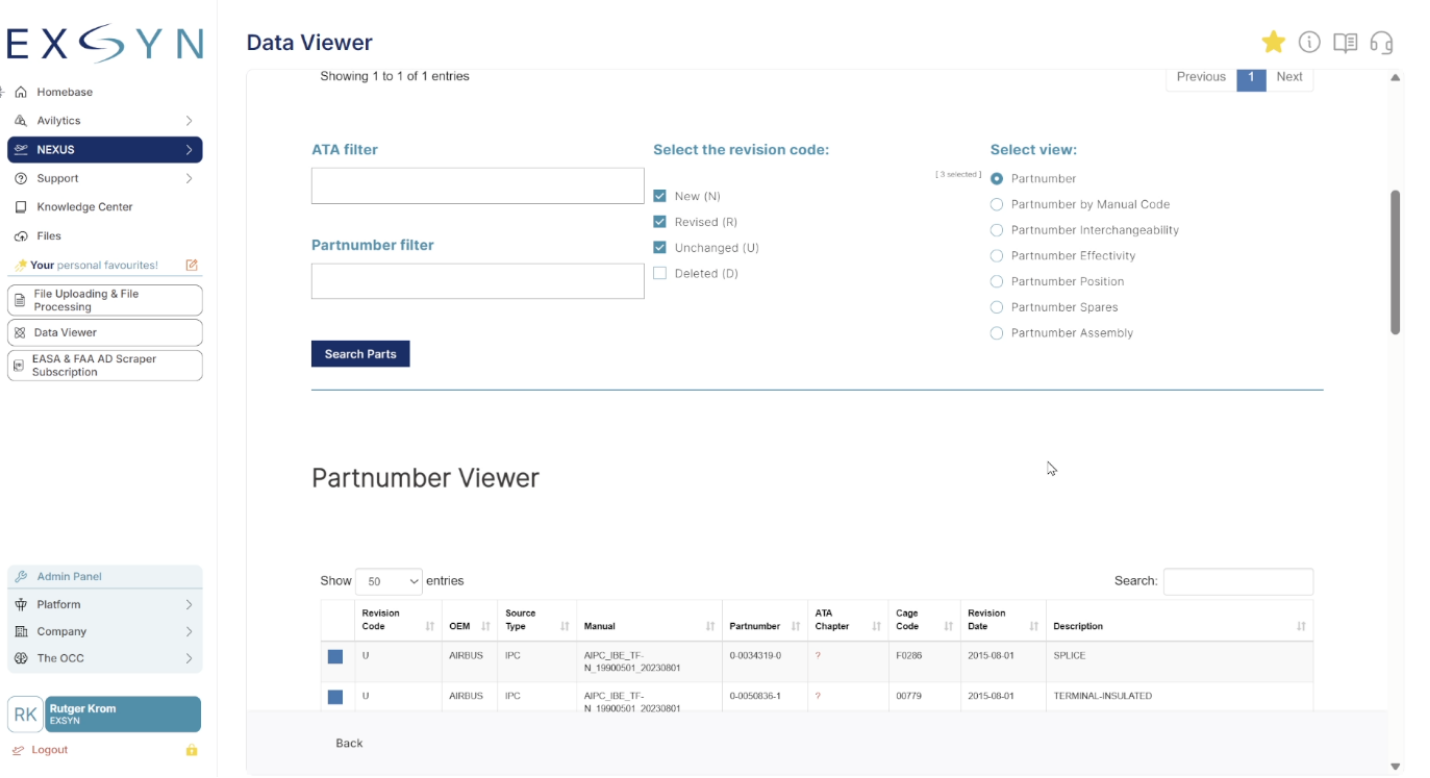
OEM Library helps engineering teams narrow a complete OEM revision to the records that require review.
Keeping Airworthiness Directive monitoring under control
Airworthiness Directives create a different type of workload because the monitoring process is continuous. Engineering teams need to monitor authority sources, identify new publications and revisions within fleet scope, retrieve the corresponding information, and establish whether the relevant AD is already being tracked internally.
This creates a simple control question: Are all potentially relevant ADs being tracked in the operator's M&E environment?
The AD Integration App supports this workflow by connecting regulatory publications with the operator's fleet context. Configured authority sources can be monitored for new or revised publications, while information within scope can be compared with AD references already present in the connected M&E system.
The technical applicability decision remains with engineering. The application helps reduce the monitoring, retrieval, and information preparation required before that assessment takes place.
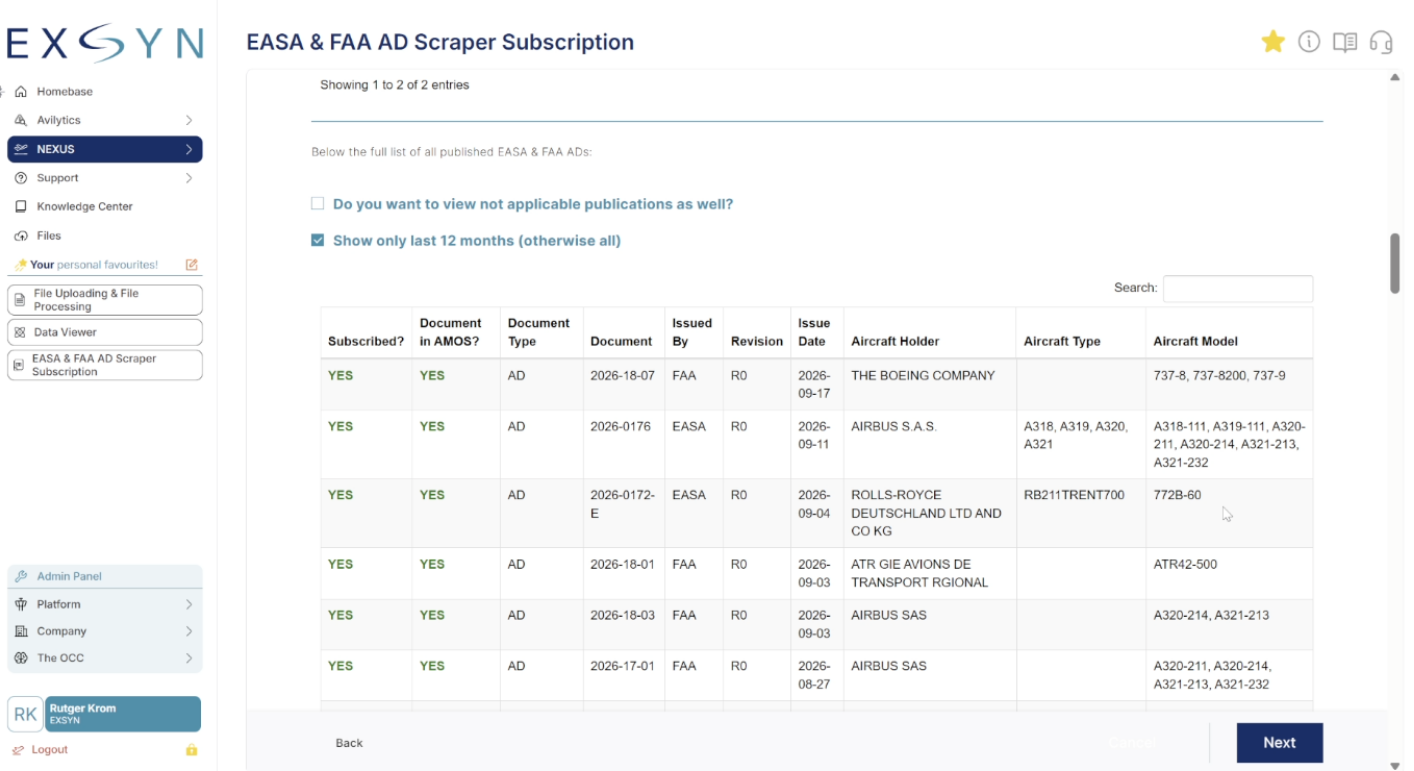
Configured authority sources can be monitored continuously against the operator's fleet scope.
Finding questionable aircraft data before it travels further
A data issue does not always create an obvious system error. During the webinar, we discussed an aircraft-utilisation example where a flight duration was significantly different from the historical pattern for the same sector. The record had entered the M&E environment normally, but the Health Check identified the value as unusual and brought it to engineering for review.
This is where Health Checks within Airworthiness Reviews & Checks support engineering teams.
Checks can run for a specific aircraft or situation, or be scheduled across selected aircraft and fleets. Results distinguish between records that pass, warnings that require review, and errors that have failed a defined validation rule. The application narrows the dataset; engineering determines what the exception means and what action is required.
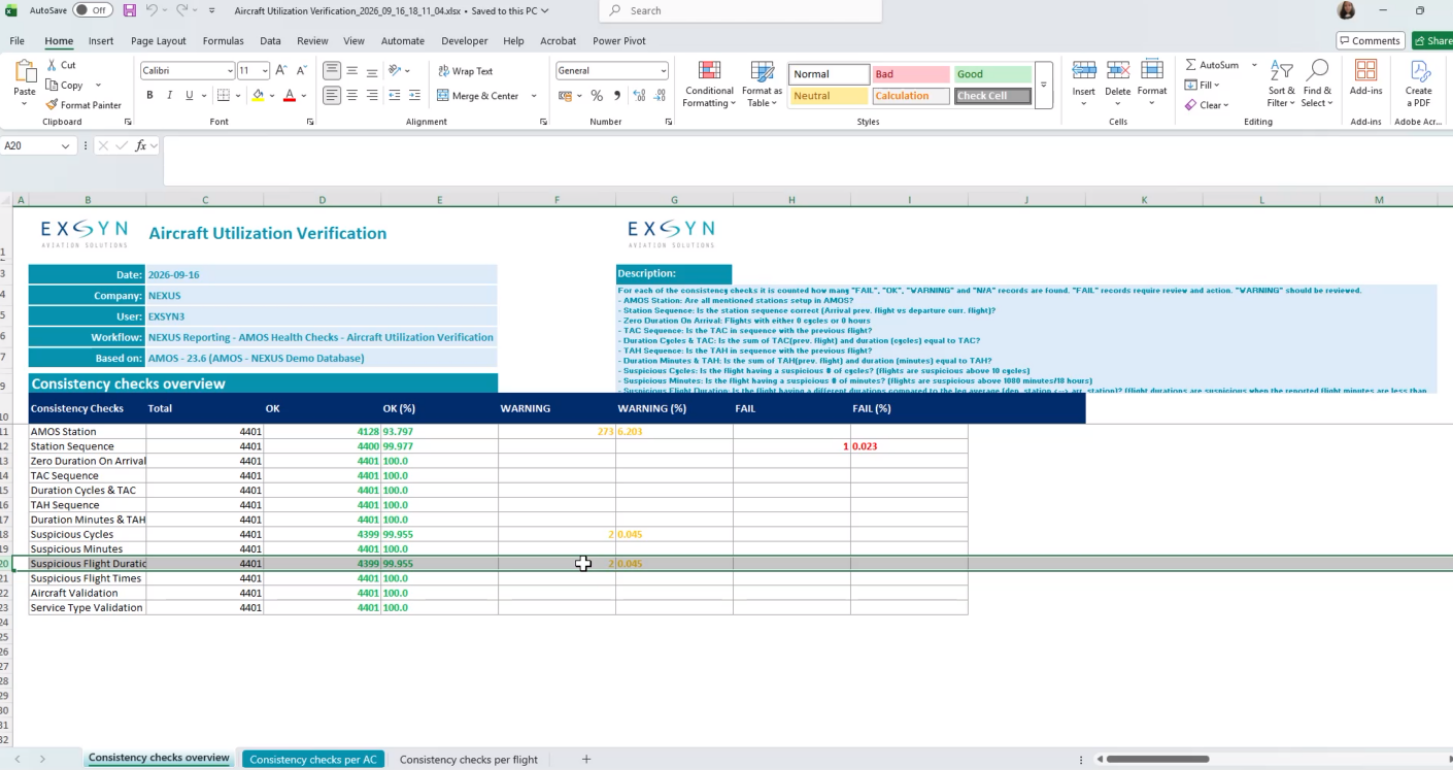
Health Checks bring unusual or inconsistent aircraft records to engineering before they quietly feed other operational processes.
A question from the webinar
Some verifications are already offered by AMOS APN 1427. What are the significant differences with EXSYN Health Checks?
The Health Checks provide additional logical validations and can go into more detail across several areas of M&E data. They can also be scheduled periodically, filtered to a fleet or individual aircraft, and used to follow identified inconsistencies over time.
Another question focused on false positives: A Health Check warning can be unusual without being wrong. How do you prevent engineers from being overwhelmed by false positives?
The distinction between a warning and an error helps engineering prioritise the review. A warning identifies something that deserves attention, while an error means that the record has failed a defined validation rule. The aim is to reduce a large dataset to a much smaller set of records requiring engineering attention.
Using maintenance analytics to understand where capacity is being used
Once we move from individual engineering records to engineering and maintenance performance as a whole, the management question changes. A manager may already know that deferrals are increasing, a work package is taking longer than expected, or maintenance effort differs from plan. The next step is understanding where that difference is occurring and where the team should look first.
The webinar explored this through three views within Engineering & Maintenance Analytics:
Planning Efficiency
Work Package Ground Time Prediction
Production Effectiveness
Planning Efficiency: Where is work repeatedly being moved?
Planning Efficiency helps teams move beyond a headline planning KPI and identify the patterns underneath it. The dashboard can show where tasks are repeatedly deassigned, which work packages or stations appear most often, and which reasons are associated with those movements. Examples demonstrated during the webinar included longer ground time requirements, unavailable parts, and new task-card revisions.
This gives planning teams a more focused starting point for review rather than requiring them to reconstruct the pattern from separate reports.
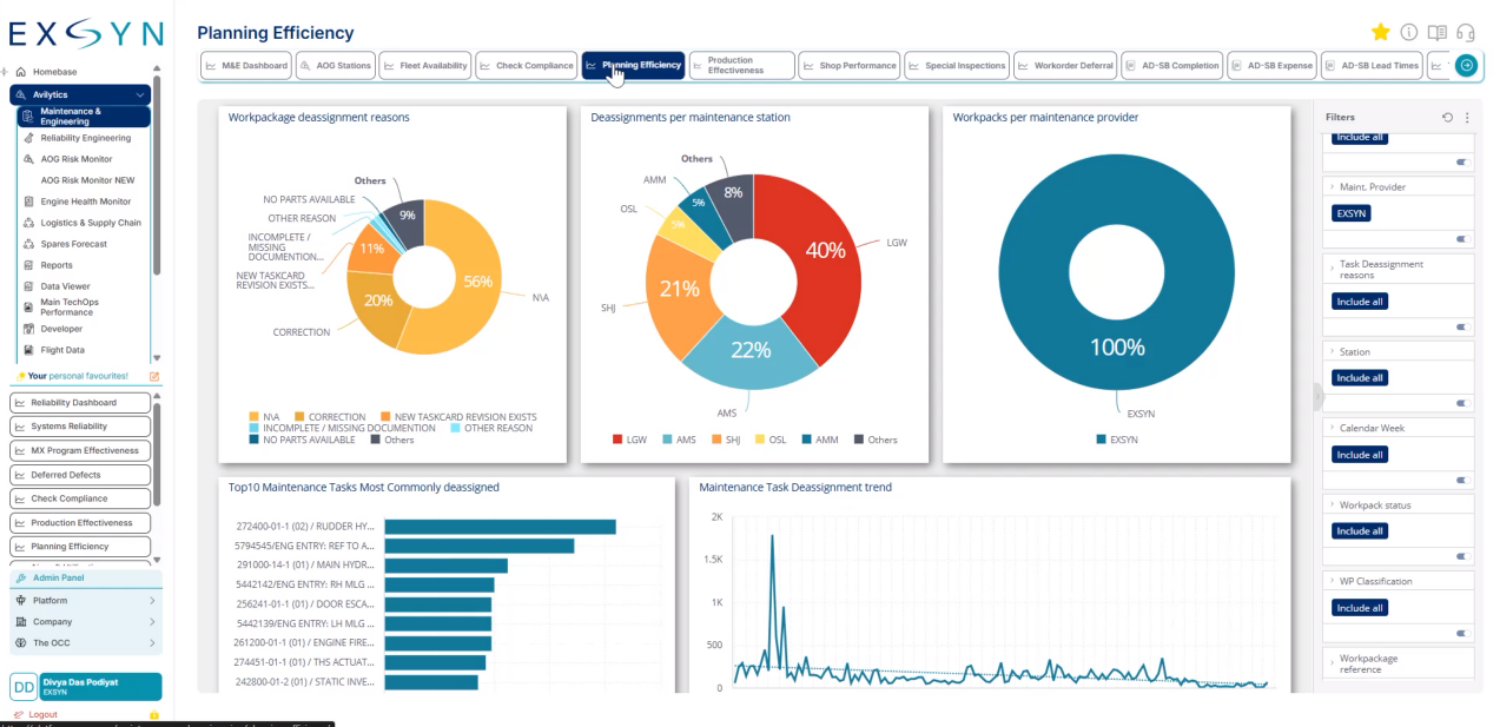
Planning Efficiency helps teams identify where maintenance work is repeatedly being moved and where planning review should begin.
Work Package Ground Time Prediction: an earlier signal for upcoming maintenance
Historical maintenance data can also help planners identify upcoming work packages that deserve closer attention. Work Package Ground Time Prediction uses previous maintenance performance together with scheduled maintenance information to highlight upcoming work packages that may require additional ground time or manpower.
In the webinar demo dataset, the 90-day horizon contained more than 1,400 planned work packages, with 59 identified as high-probability cases. One C-check example showed a prediction of 238 additional man-hours based on historical C-check information. These numbers are demonstration data rather than customer benchmarks.
The purpose is to give planners an earlier signal of where additional review may be useful. It does not replace full capacity planning for future work orders.
One audience member asked: How does the application support maintenance planners in forecasting upcoming workload and resource requirements?
The application does not perform end-to-end capacity planning for future work orders. It helps planners analyse historical maintenance information and identify patterns that can support upcoming planning and resource decisions.
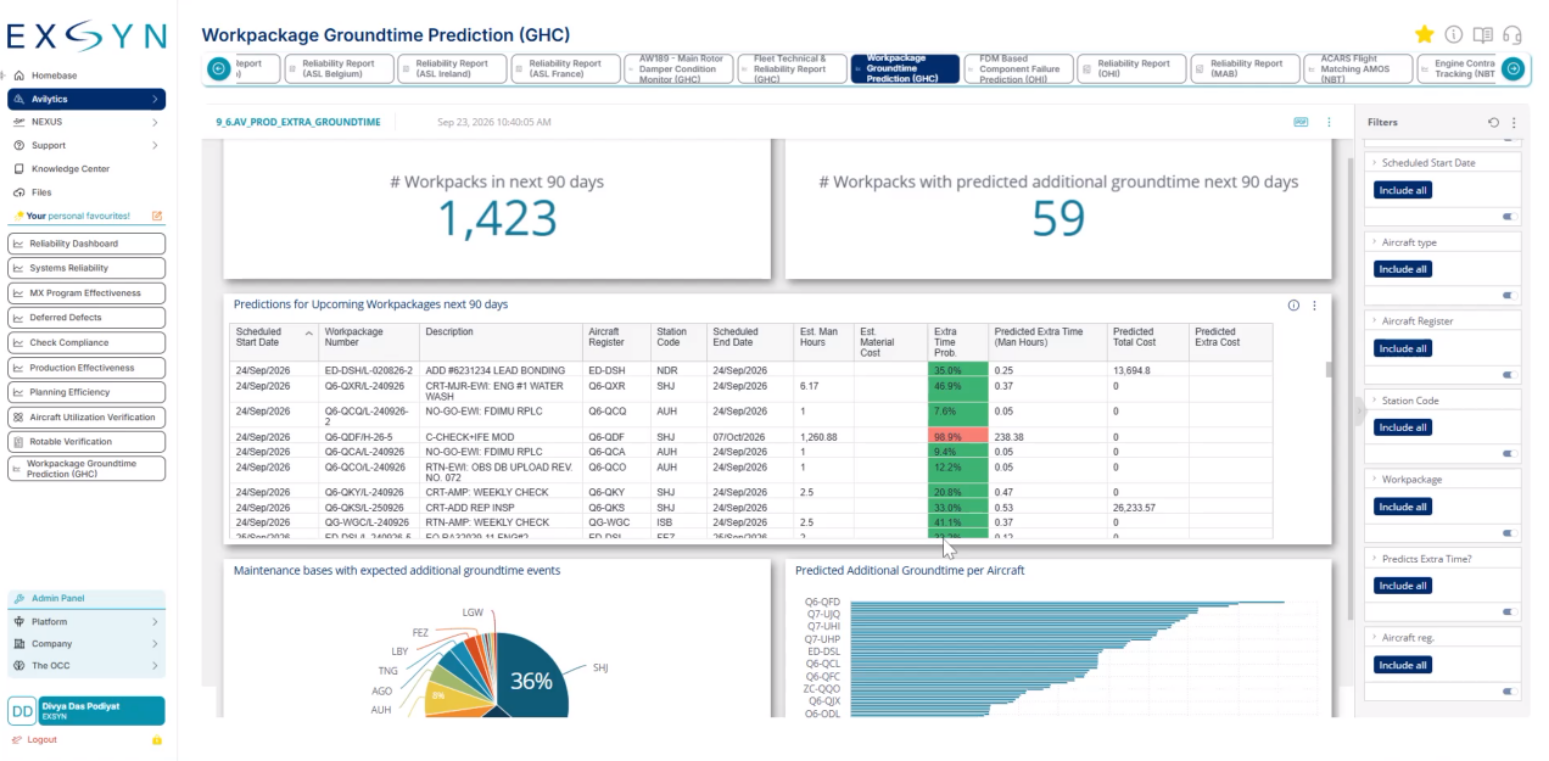
Historical maintenance data can provide an earlier indication of upcoming work packages that may require additional ground time or manpower.
Production Effectiveness: where did actual maintenance effort differ from plan?
After maintenance has been completed, the question becomes retrospective: Where did actual maintenance effort differ from what was planned?
Production Effectiveness compares planned or estimated man-hours with the hours actually booked against completed maintenance work. Teams can then move from the overall work-package variance into the individual tasks where the difference occurred.
The application shows where the variance is visible. Planning, engineering and maintenance teams investigate what caused it.
A useful question raised during the webinar was: A work package can overrun ground time without using more man-hours. What would that tell you?
Ground time and man-hours represent two different dimensions of maintenance performance. If ground time increases without additional man-hours, the team may investigate other constraints such as tooling, spare-parts availability or conditions at the maintenance base. The variance identifies where further investigation is needed; the team determines the underlying cause.
Another question addressed the quality of labour booking: If engineers do not book hours accurately, won't Production Effectiveness become misleading?
Production Effectiveness relies on the labour hours recorded against maintenance tasks. Incomplete or inconsistent time booking therefore reduces the reliability of the resulting variance. Consistent time-booking practices remain important for meaningful comparison between planned and actual maintenance effort.
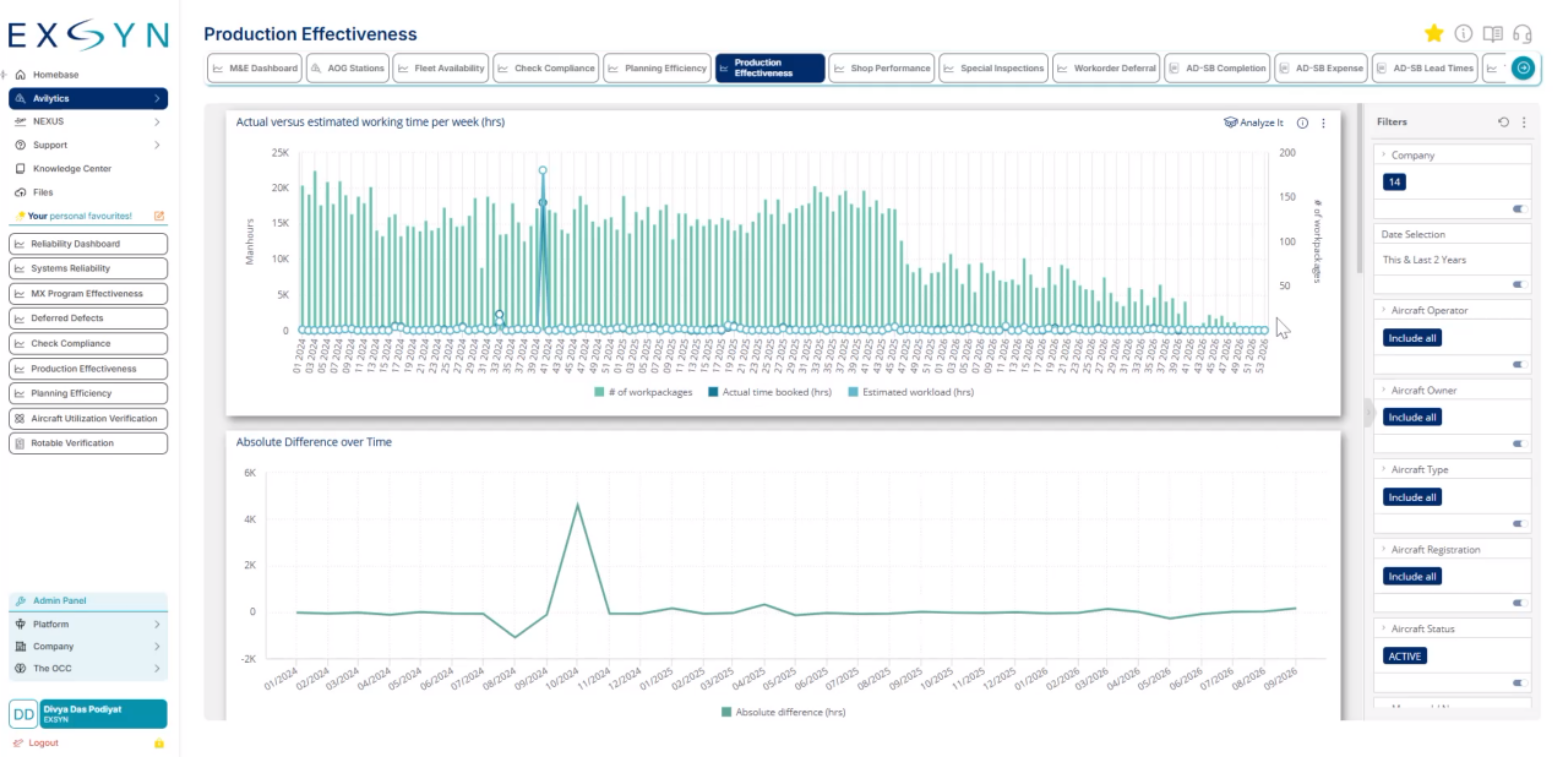
Production Effectiveness helps teams locate maintenance-effort variances before drilling into the work packages and tasks behind them.
Engineering productivity is also about where expertise is spent
Across the workflows demonstrated in the webinar, a common pattern emerged. OEM Library reduces the preparation required to understand revision changes. AD Integration supports continuous regulatory-information monitoring. Airworthiness Reviews & Checks bring questionable aircraft records to engineering. Engineering & Maintenance Analytics provides more detail on planning patterns, upcoming work-package risk, and maintenance-effort variance.
At the engineering level, the aim is to get technical teams faster to the records, changes, and exceptions that require their expertise. At the management level, the aim is to provide enough visibility to understand where capacity is being used and where planning or execution deserves closer investigation.
This fits into a broader progression towards Operational Confidence: trusted operational information supports stronger engineering decisions today and creates the foundation for more advanced reliability, predictive, and AI-assisted capabilities over time.
If these challenges are relevant to your engineering or maintenance operation, watch the full session to see the workflows demonstrated in practice.