
How CAMO Teams Can Reduce Manual Review of OEM Revisions and Airworthiness Directives
A new IPC revision has been released. Several hundred or several thousand records sit behind the update, but only part of that information may have changed. Somewhere else in the same working day, a new Airworthiness Directive appears from an authority source and needs to be checked against the operator’s fleet and the information already controlled in the M&E system.
For a CAMO engineer, both situations can’t be more familiar. The workload builds in the steps that follow: identifying what changed, narrowing the review to the affected information, checking aircraft or component context, comparing external information with the operator’s records, and deciding what requires action.
These activities sit between the publication of technical information and the controlled engineering decision. They are also where repeated checking can absorb a significant amount of specialist time, particularly when OEM, authority, and M&E information are maintained in different environments.
Two workflows illustrate how this preparation can be made more controlled: OEM revision management through EXSYN OEM Library, and continuous Airworthiness Directive monitoring through AD Automation.
OEM Revisions: Start the Review With What Actually Changed
Technical publications are revised continuously throughout the life of an aircraft. An updated IPC can introduce changes to part numbers, effectivity, positions, assemblies, or interchangeability. AMM and other OEM revisions create similar review requirements for Engineering.
For the engineer responsible for assessing the revision, the first useful question is usually straightforward: what changed compared with the previous revision?
Working through the complete publication again provides an answer, but it also creates considerable preparation around the engineering assessment. Where a revision contains thousands of records and only a relatively small number have changed, the useful review population is much smaller than the complete dataset.
The EXSYN OEM Library App structures OEM revision information so that records can be identified according to their revision status. For an IPC, engineers can distinguish information that is new, revised, unchanged, or deleted, then narrow the review further using criteria such as ATA chapter, part number, and effectivity. EXSYN’s current OEM Library workflow also supports controlled revision handling and the use of OEM information within connected M&E processes.
For a CAMO or Engineering department organised around ATA responsibilities, this creates a more practical starting point. An engineer responsible for a particular system can focus on the changed records within the relevant ATA chapter and examine the associated part, effectivity, or interchangeability information before deciding whether anything in the operator’s environment requires attention.
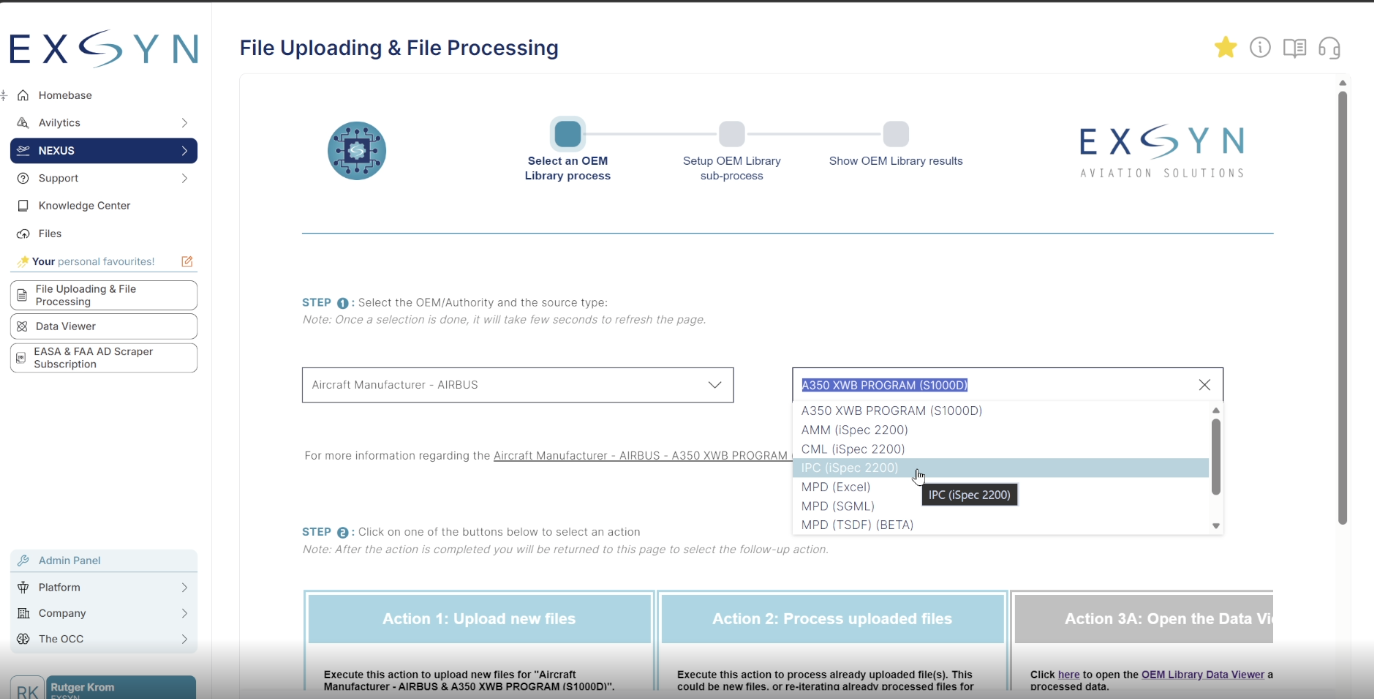
OEM Library narrows an OEM revision to the records that require engineering review, with revision status and engineering filters helping teams focus on relevant changes.
Effectivity Still Has to Be Read Against the Actual Aircraft
Revision status alone cannot determine what an OEM change means for an operator. Effectivity may indicate that a change applies to a specific aircraft, configuration, or component population, while the operator’s actual configuration provides the context needed for a final assessment.
This becomes particularly relevant when OEM effectivity information and the configuration recorded internally do not appear to align. The workflow can present the OEM information in a reviewable form, but the CAMO or Engineering team still evaluates it against the aircraft configuration and decides what to update or approve.
The same principle applies when comparing IPC information with data already maintained in the M&E system. A part may already exist internally, yet its ATA chapter, subject, description, or interchangeability setup may differ from the latest OEM source. Those differences deserve review because they can affect the context in which the information is subsequently used.
This type of comparison is particularly valuable for CAMO teams because “record exists” and “record remains aligned with the current technical source” are different control questions. The second requires continued verification as publications and aircraft configurations evolve.
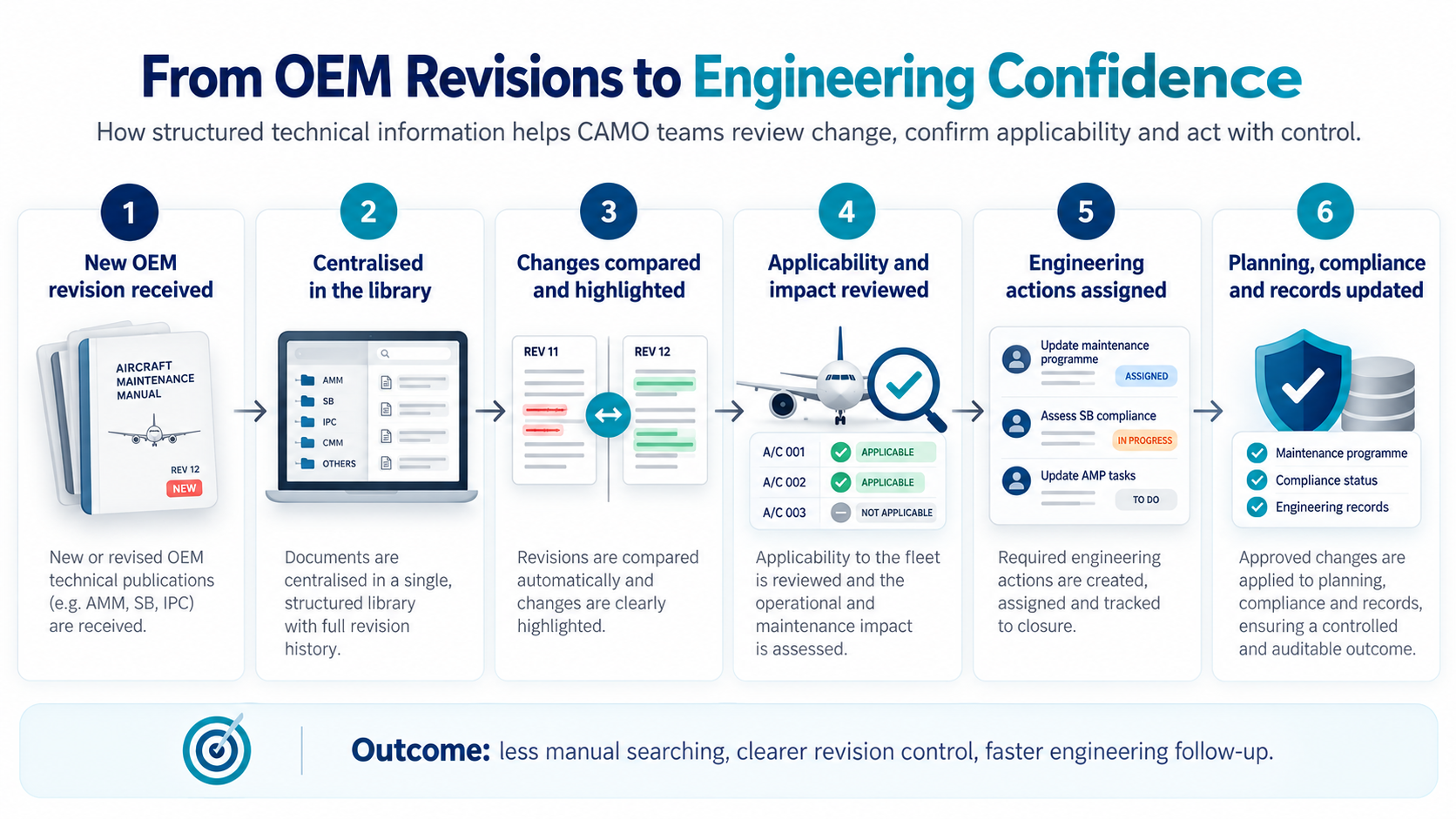
This workflow shows how structured OEM technical information helps CAMO teams manage revision changes more efficiently. It illustrates the process from receiving updated OEM publications, centralising them in a library, identifying changes, reviewing applicability and impact, assigning engineering actions, and updating planning, compliance and records.
AD Monitoring Has a Different Rhythm
Airworthiness Directive management creates a more continuous workload. Authority sources need to be monitored for new publications and revisions, potentially relevant directives need to be brought into the operator’s workflow, and Engineering needs enough information to determine applicability and required action.
The process therefore extends well beyond receiving the PDF or notification.
A typical CAMO sequence begins with monitoring the applicable authority sources and identifying new or revised publications within the operator’s fleet scope. The next control point is internal: does the M&E environment already contain the corresponding AD information, and does the recorded information provide the basis needed for Engineering to continue the assessment?
The EXSYN AD Automation workflow supports this preparation by monitoring configured authority sources, retrieving new or revised AD information, and connecting that information with the operator’s fleet and M&E environment. The current EXSYN application supports sources including EASA and FAA and is designed to prepare regulatory information for the operator’s own applicability and compliance process.
The engineer remains responsible for applicability. Aircraft configuration, modification status, installed components, and other technical factors still need to be considered before the CAMO establishes how an AD is handled.
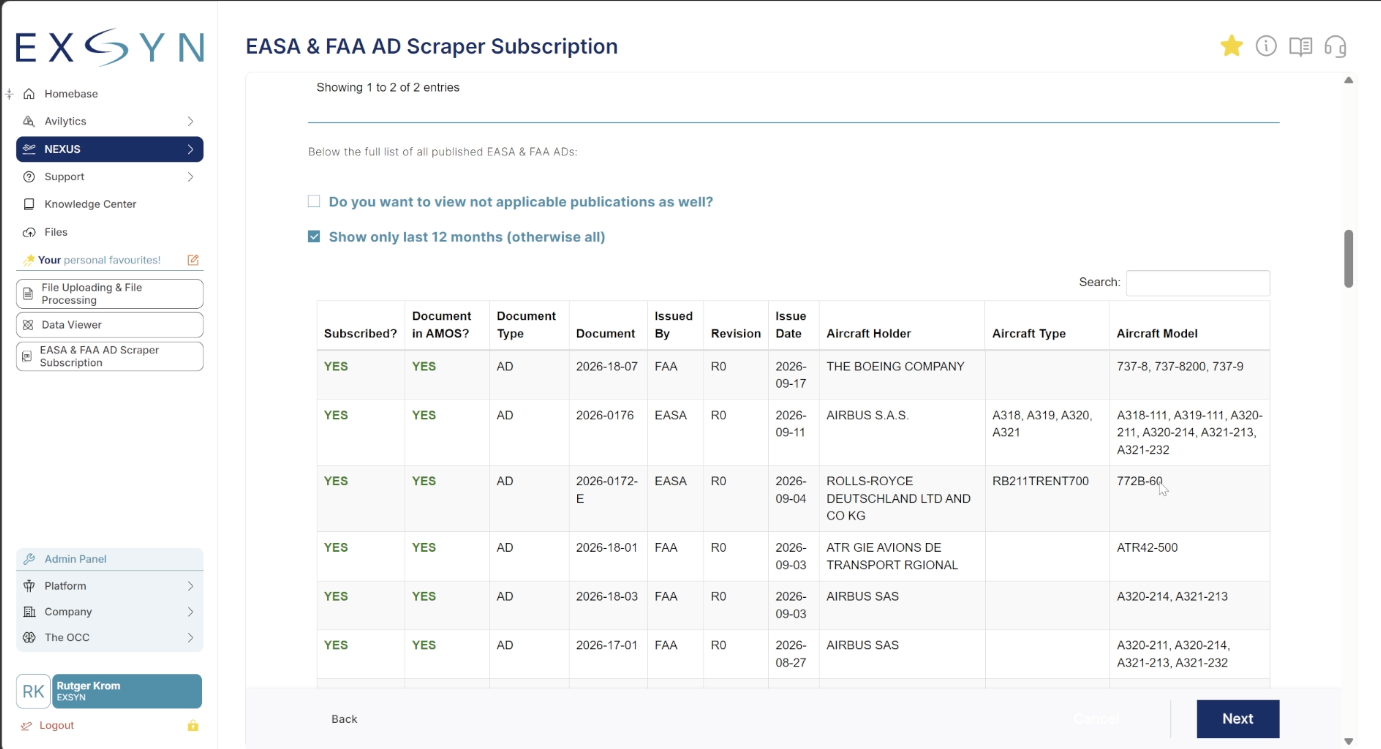
AD Automation monitors configured authority sources and brings potentially relevant publications into a controlled workflow for CAMO and Engineering review.
A Missing Internal Reference Is a Useful Exception to Surface
Consider a practical example. A newly published AD appears relevant to the operator’s fleet scope, but no corresponding AD reference can be identified in the connected M&E system.
That difference warrants investigation.
It does not establish non-compliance on its own. The directive may ultimately prove non-applicable after engineering assessment, the information may be recorded under another reference, or another valid explanation may exist. What matters operationally is that the difference between the external regulatory source and the internal environment becomes visible to the team responsible for resolving it.
For a CAMO engineer, this shifts part of the workload from broad searching towards exception review. Instead of relying entirely on repeated manual checks between authority websites and internal records, Engineering receives a narrower set of items where the two environments require reconciliation.
For a CAMO manager, the same workflow provides greater visibility over whether the monitoring process is functioning consistently. It becomes easier to distinguish routine information handling from the cases that genuinely require technical attention.
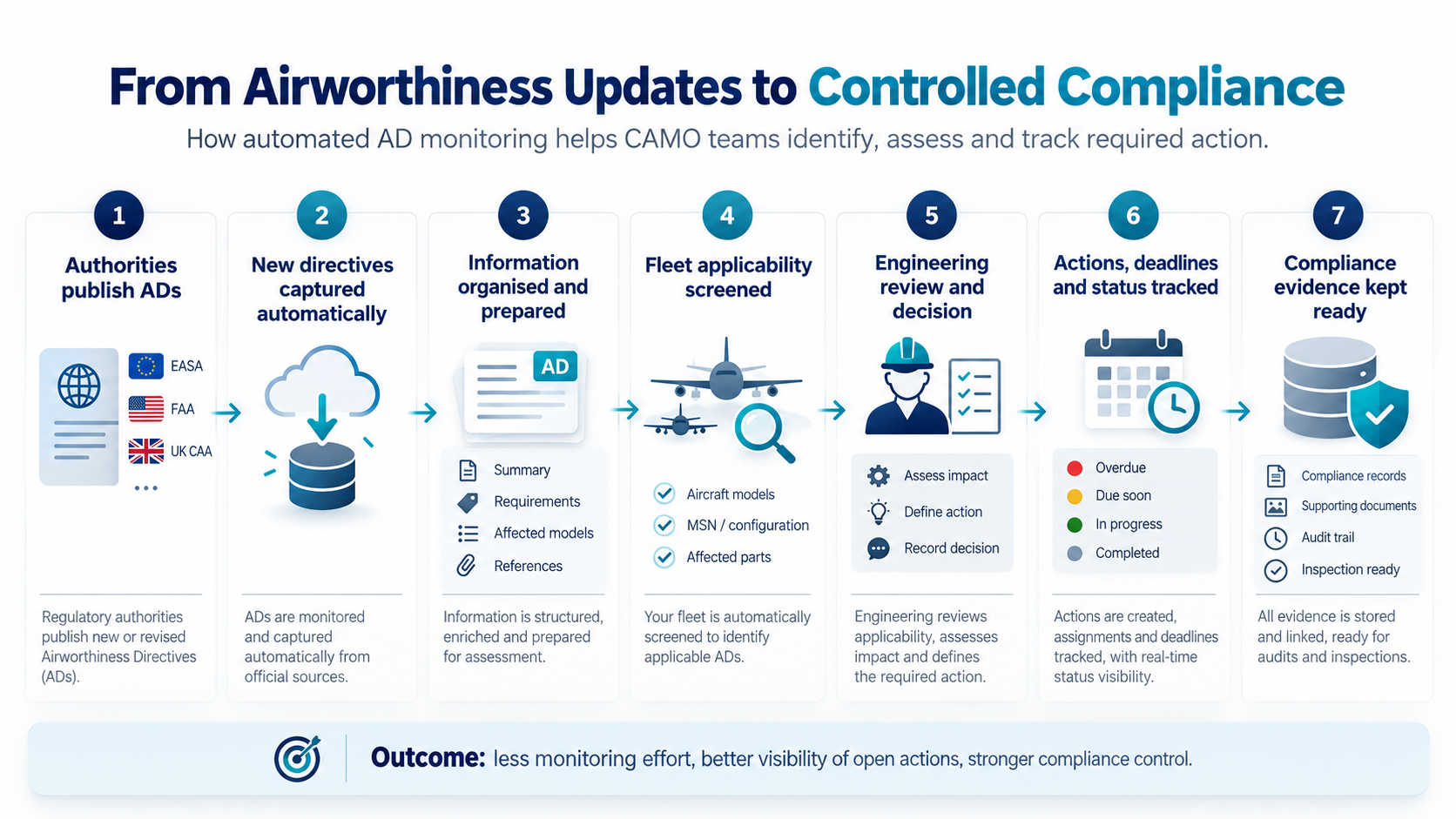
This workflow shows how automated AD monitoring supports CAMO teams in managing airworthiness directives. It covers the process from published directives and automated capture through information preparation, fleet applicability screening, engineering review, action tracking and compliance record readiness.
Two Sources, One Controlled Engineering Process
OEM publications and Airworthiness Directives enter the CAMO environment through different channels and carry different technical implications. The operational pattern around them is nevertheless closely related.
For OEM information, the workflow begins with a new revision, identifies the changed information, narrows it according to engineering context, and brings the relevant records forward for review. Engineering then determines whether the operator’s current information or configuration requires an update.
For ADs, the workflow begins with continuous authority monitoring, identifies new or revised publications within scope, compares them with information already controlled internally, and brings potential gaps into the applicability process. Engineering establishes applicability and controls the resulting action.
This distinction is important. Automation prepares, structures and compares information; the CAMO retains authority over the technical assessment. The objective is to give engineers a better-defined review population and clearer context before they make the decision.
The M&E System Remains the Operational System of Record
Most CAMO organisations already operate a capable M&E platform. The recurring effort often develops around the interfaces between that system and the information sources surrounding it.
OEM portals publish revised technical information. Authorities issue and amend Airworthiness Directives. Aircraft configuration continues to change through modifications and component activity. Engineering decisions then need to be reflected in the system used to control the aircraft’s continuing-airworthiness status.
This creates a series of handovers where information can require validation, preparation or reconciliation before it can be used confidently.
EXSYN’s role in these workflows is to work around the existing M&E environment. The OEM Library and AD Automation workflows prepare external technical information and connect it with the context already held by the operator, while the M&E system continues to perform its role as the operational system of record.
For CAMO teams, that matters because introducing another source of truth would add complexity to an environment that already contains several specialised systems. The more useful outcome is a controlled flow of information into the processes engineers already use.
What Changes for the CAMO Engineer?
The practical difference can be seen in the starting point of the engineering task.
An OEM engineer reviewing a revised IPC can begin with the records that changed and narrow the analysis to the ATA chapters, parts and effectivity relevant to their responsibility. An airworthiness engineer reviewing AD activity can begin with new or revised publications that fall within the configured fleet scope and identify where the external information requires reconciliation with the M&E environment.
The engineering work remains detailed. Effectivity still needs interpretation. Aircraft configuration still matters. Applicability still has to be established. The resulting decisions still require the appropriate level of approval and traceability.
What changes is the amount of recurring preparation surrounding those decisions.
This is particularly relevant where CAMO teams are responsible for larger fleets, several aircraft variants or multiple authority and OEM sources. A process that depends heavily on individual engineers remembering where to look, what to compare and which records have already been reviewed becomes harder to scale consistently.
Structured workflows provide a repeatable route from publication to review while preserving the technical judgement expected from experienced CAMO and Engineering personnel.
What Changes for the CAMO Manager?
At management level, the concern is broader than the time taken to review an individual publication. Managers need confidence that the organisation has a repeatable process for bringing external technical changes into the continuing-airworthiness environment.
That includes knowing that OEM revisions are being reviewed against the relevant technical information, that regulatory publications are being monitored consistently, that discrepancies reach the appropriate engineer and that approved changes can be traced into the operational environment.
This becomes particularly important during periods of fleet change. Aircraft introductions, lease extensions, second-hand aircraft acquisitions and configuration changes increase the volume of information that needs to remain aligned. EXSYN’s Q4 CAMO focus reflects this operational reality: older and transferred aircraft can bring additional AD, SB, task and configuration information that needs to remain consistent throughout the aircraft’s continued operation.
A controlled workflow also reduces dependence on pre-audit reconstruction. When revision review, regulatory monitoring and engineering follow-up are part of the daily process, the evidence needed later for an Airworthiness Review, authority audit or aircraft transaction is easier to trace back to the decisions that created it.
From Information Control to Compliance Confidence
Continuing airworthiness depends on a long chain of technical information remaining connected as the aircraft changes. OEM revisions affect the engineering baseline. ADs introduce regulatory requirements. Configuration determines technical applicability. Engineering decisions determine what enters the controlled maintenance environment.
Maintaining these relationships is part of Aviation Data Continuity. For CAMO, the value becomes visible when engineers can move from an external change to the relevant aircraft context and supporting records without repeatedly reconstructing the information path.
That continuity supports Compliance Confidence in daily operations. The CAMO has greater visibility over which information has changed, where a discrepancy requires review and how an engineering decision connects back to the original technical source.
Over time, the same foundation also contributes to broader Operational Confidence. Reliable technical information is easier to use in maintenance planning, reliability analysis, aircraft transitions and more advanced engineering analytics because the context behind the data has been preserved.
Further Reading
For a broader view of OEM revision review, AD monitoring, aircraft data validation, and maintenance-performance workflows, see Improving Engineering Productivity as Aviation’s Technical Needs Grow – Insights and Q&A. Read the engineering productivity article
Bringing Technical Change Into a Controlled CAMO Workflow
CAMO engineers will continue to make the technical decisions behind continuing airworthiness. The opportunity is to improve the path that brings the relevant information to them.
OEM Library provides a structured route from a revised OEM publication to engineering review and controlled updates. AD Automation provides a continuous route from new regulatory information to fleet-level screening, internal comparison and applicability assessment.
Together, these workflows reduce repeated preparation around the M&E system while keeping engineering judgement, aircraft configuration and technical approval at the centre of the process. That is where automation creates practical value for CAMO: the right change reaches the right engineer with enough context to decide what happens next.
Frequently Asked Questions About OEM Revision and AD Review
-
By structuring revision data so engineers can focus on records that are new, revised or deleted and then narrow the review by criteria such as ATA chapter, part number and effectivity. Engineering still determines whether the change requires action.
-
Yes. Monitoring, retrieval and comparison against fleet and M&E information can be automated or structured, while technical applicability remains an engineering responsibility.
-
No. EXSYN works around the existing M&E environment, helping prepare, validate and connect information while the operator’s M&E system remains the operational system of record.