
For CAMO and Airworthiness Engineering teams, Airworthiness Directive control depends on more than receiving the latest publication from an authority. Each potentially relevant AD still has to be brought into the operator’s controlled process, assessed against the applicable aircraft or component configuration, and represented correctly in the M&E environment.
Most of the time, those information paths align. Occasionally, they do not.
One of the checks within this workflow compares potentially relevant ADs against the information already controlled in the operator’s M&E environment. An AD may fall within the relevant aircraft or component effectivity scope while no corresponding initialised or tracked record can be identified internally. This does not by itself establish a compliance problem. It creates a specific exception for Engineering to investigate.
The Control Question Behind AD Monitoring
Airworthiness Directive management involves several connected checks. The authority publication defines the technical requirement and effectivity. The operator’s fleet and component configuration determine whether the directive may be relevant. The M&E system then provides the internal record against which applicability, compliance status, and follow-up actions are controlled.
A basic CAMO control question therefore sits behind the process: Are all potentially relevant ADs represented in the operator’s controlled M&E environment?
Answering that consistently becomes harder as fleets, configurations and regulatory information change. New ADs are published, existing directives are revised, components move between aircraft, modifications alter configuration, and aircraft may enter the fleet with maintenance histories created under another operator or system.
The individual records may all exist, while differences between external effectivity information and the internal M&E picture remain difficult to identify through routine review alone.
When the Comparison Surfaces an Exception
Once that difference has been surfaced, Engineering has a much more focused starting point. Instead of working systematically through every authority publication and comparing it manually with every internal record, the team can concentrate on the smaller number of exceptions that require investigation.
The finding itself is deliberately narrow: external AD information indicates that the directive deserves review against the operator’s fleet context, while the expected internal reference has not been identified.
The engineer can then work back through the technical context: Was the effectivity interpreted correctly? Is the aircraft configuration recorded accurately? Is the relevant component actually installed? Has the AD been controlled under another internal reference? Was an earlier applicability assessment made that explains why no active record exists?
It remains a prompt for engineering investigation, not an automated compliance conclusion.
An Exception Does Not Automatically Mean Non-Compliance
This distinction is important. A missing internal reference can have several explanations. The AD may ultimately prove non-applicable because of the aircraft’s modification status or installed configuration. A component part number or serial-number range may exclude the asset after a more detailed assessment. The directive may already be controlled under another internal reference, or the M&E record may have been initialised differently from the external publication.
There can also be cases where the investigation confirms that information does need to be corrected or added.
The role of the check is to make the discrepancy visible. The CAMO or Engineering team still determines applicability, reviews the relevant aircraft and component context, and decides whether any change to the controlled airworthiness record is required.
This preserves the distinction between automated information preparation and engineering judgement.
Why Effectivity Matters
AD control depends heavily on effectivity. Aircraft type alone is rarely sufficient to establish the complete applicability picture. Depending on the directive, Engineering may need to consider MSN, installed components, part numbers, serial numbers, modification status or another configuration condition before reaching a conclusion.
This makes aircraft configuration an essential part of the review. If the regulatory source and the M&E system are assessed independently, the engineer has to reconstruct that relationship during each investigation. A more structured comparison brings the external AD information together with the fleet context and identifies where the expected internal representation does not appear to match.
The engineer can then work from the exception back to the technical basis: which effectivity criterion triggered the result, which aircraft or components are involved, what configuration is actually installed, and how the directive is currently represented internally.
That is a much more focused starting point than a broad manual comparison of authority sources and M&E records.
From Broad Checking to Exception Review
For experienced CAMO engineers, the technical assessment itself remains the important part of the work. The repeated preparation around that assessment is where a significant amount of time can accumulate.
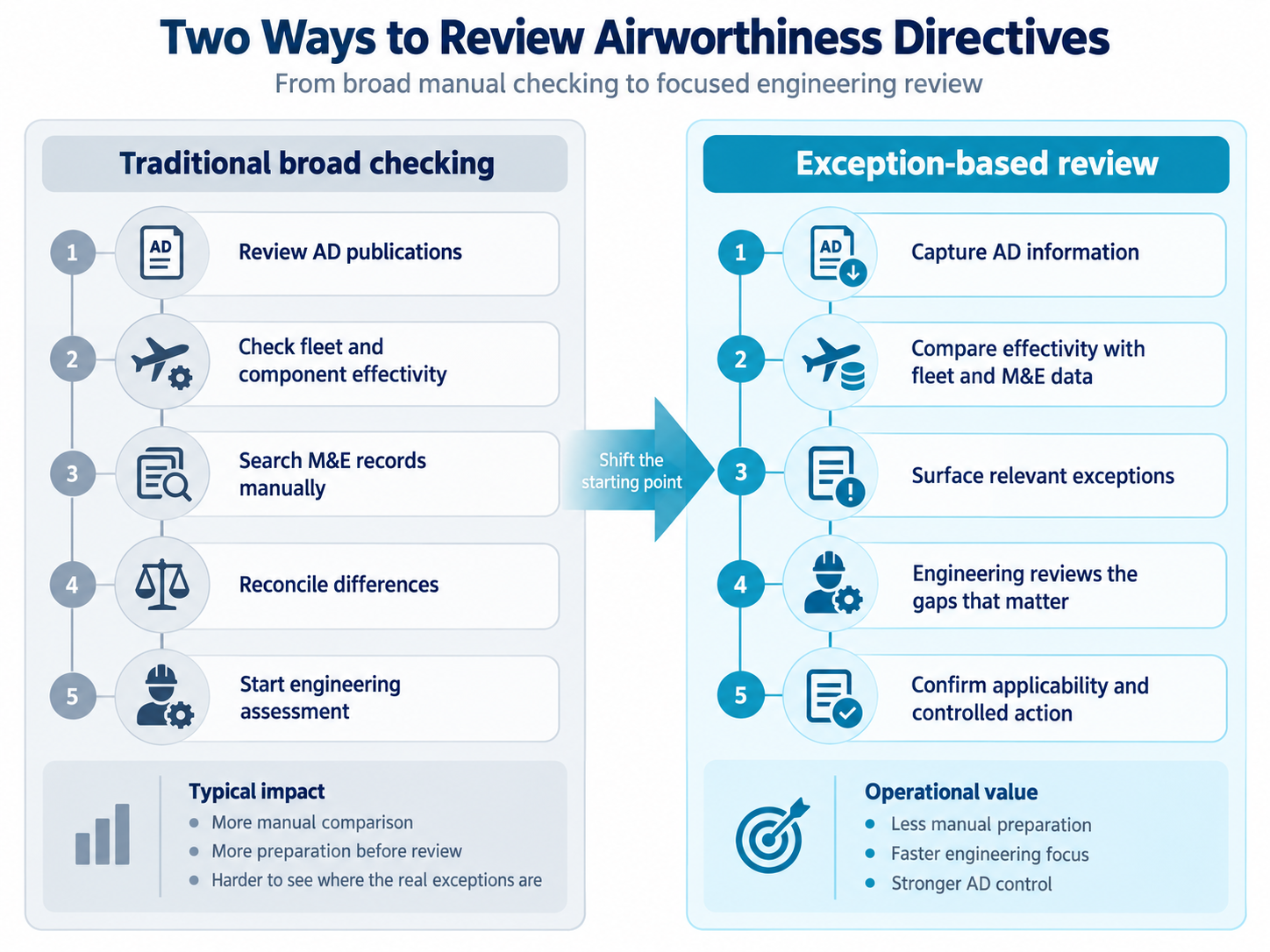
Manual AD control can involve checking authority sources, identifying revisions, filtering for fleet relevance, searching the M&E environment for corresponding references and reconciling differences before the engineer can begin the applicability review.
An exception-based workflow changes that sequence. Regulatory information and fleet context are prepared first, differences are surfaced, and Engineering begins with the subset of records that require attention.
The objective is not to remove technical review. It is to reduce the amount of undifferentiated checking required before that review starts.
For a CAMO manager, the same approach provides another benefit: greater visibility into where regulatory information and the controlled M&E environment may have drifted apart. The team can focus its capacity on identified exceptions rather than relying solely on periodic broad checks or individual knowledge of where discrepancies are most likely to occur.
Keeping the M&E System at the Centre of the Process
The M&E system remains the operational system of record for the airline’s continuing-airworthiness processes. The purpose of an external validation or AD monitoring workflow is therefore not to create a competing compliance record.
Its role is to compare external regulatory information with the context already maintained by the operator and bring potential differences to Engineering.
This is also why the distinction between “an AD exists externally” and “the AD has been assessed and controlled internally” matters. Authority publications, aircraft configuration and internal airworthiness records represent different parts of the same continuing-airworthiness process. Confidence depends on maintaining the relationship between them as each changes over time.
EXSYN’s AD Automation and airworthiness checking capabilities are designed around this operating model: prepare and compare the information around the existing M&E environment, surface the exceptions that deserve attention, and keep the final engineering assessment with the operator.
A Small Data Gap Can Reveal a Larger Process Issue
A single missing or differently initialised AD reference may be straightforward to resolve. The wider value lies in what the exception says about the information flow supporting the CAMO process.
If external regulatory information, aircraft effectivity and internal M&E records are not being reconciled consistently, the same type of discrepancy can reappear as the fleet changes. Aircraft acquisitions, lease extensions, component movements, modifications and system migrations can all introduce additional opportunities for information to diverge.
For that reason, exception checks are useful beyond the individual record they identify. They provide a way to test whether the information relationships behind continuing airworthiness are being maintained consistently.
This is closely related to Aviation Data Continuity: keeping aircraft configuration, regulatory information, maintenance history and engineering decisions sufficiently connected that the current airworthiness position can be established without repeatedly reconstructing the underlying information.
From Daily AD Control to Compliance Confidence
Audit readiness often exposes these relationships because an authority or reviewer asks the CAMO to demonstrate how an applicability or compliance decision was reached. By that point, the relevant evidence may span the authority publication, configuration history, internal AD assessment and maintenance records.
The stronger approach is to identify and investigate discrepancies as part of daily airworthiness control rather than discovering them while preparing for an audit or Airworthiness Review.
When potentially relevant ADs can be compared with the information already controlled in the M&E environment, CAMO teams gain a clearer view of where attention is required. Engineering can then establish whether the exception reflects a valid applicability decision, a different internal reference or a record that needs correction.
That is the practical meaning of Compliance Confidence: the ability to understand and demonstrate the continuing-airworthiness position because the information behind it has been checked, connected and reviewed as part of the normal engineering process.
The Proof Is the Exception
The value of this workflow lies in making the exception visible before Engineering begins its technical assessment. A potentially relevant AD that does not appear where Engineering expects it to appear is brought into view.
From there, the CAMO team does what it is responsible for doing: review the technical basis, confirm effectivity and configuration, assess applicability, and determine whether any controlled action is required.
By narrowing a broad regulatory-information environment to the specific exceptions that deserve technical attention, CAMO teams can spend less time searching for possible gaps and more time resolving the ones that actually need engineering judgement.

Frequently Asked Questions About AD Effectivity and M&E Data Checks
-
AD effectivity defines the aircraft, engine, component or configuration conditions to which an Airworthiness Directive may apply. Engineering still needs to assess the operator’s actual configuration before confirming applicability.
-
It does not automatically mean the aircraft is non-compliant. The AD may be recorded differently, may ultimately be non-applicable, or may require further engineering investigation.
-
Parts of the monitoring and preparation process can be automated, including identifying new publications, screening fleet scope and comparing information with M&E records. The final applicability assessment remains an engineering responsibility.