
Ask an engineering team how long a fleet-wide report takes, and you usually get two answers. One is the time it takes to produce the report; the other is the time it takes to trust it.
The second number is the one nobody plans for. Utilisation figures that do not match between systems. A component history with a gap in it. An effectiveness check repeated because the latest revision was incorporated somewhere else. These are not analytics problems in themselves. They are symptoms of engineering data that requires validation before it can be used, and in many aviation organisations that work is absorbed quietly by the most experienced people available.
That matters because it changes what kind of problem this is. If your reporting is slow, the answer usually is not better reporting. It is whatever sits underneath it.
Five Stages of Aviation Engineering Data Readiness
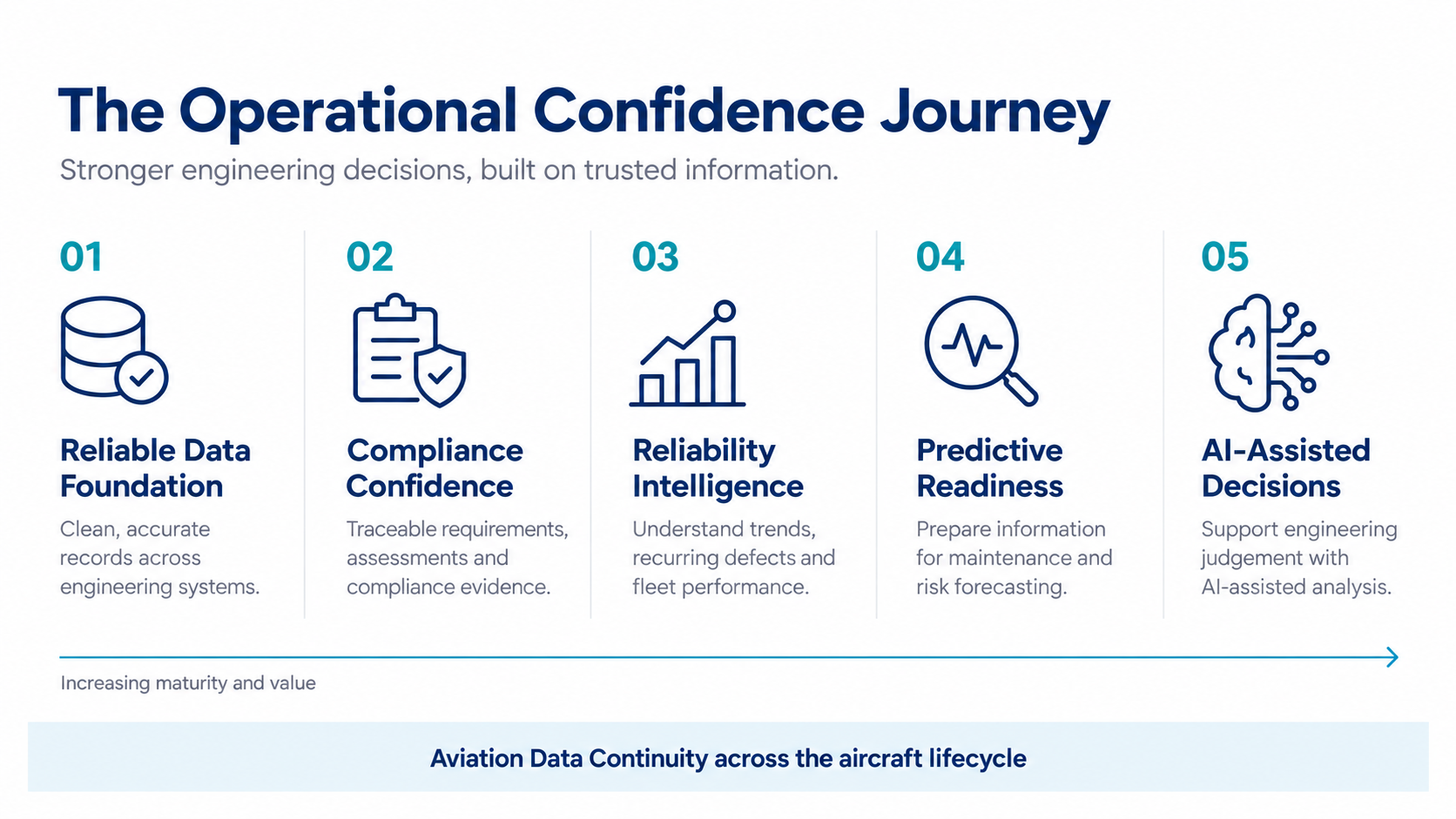
Operational confidence develops over time, as operational information becomes more reliable, connected and accessible across the aircraft lifecycle. We describe that progression in five stages.
Stage 1. Stage 1. Reliable data foundation. Operational information that is complete, connected and consistent enough for engineers to use with confidence, without repeatedly reconciling the same records before analysis can begin. This includes aircraft and component records, technical data management, data quality and governance, and integration between the systems that create and maintain that information.
Stage 2. Compliance confidence. Continuing airworthiness where the supporting evidence is already available rather than assembled on request. This includes compliance tracking, airworthiness reviews, technical log accuracy and regulatory reporting. The difference becomes visible both in daily CAMO decisions and when an audit or Airworthiness Review needs to be supported.
Stage 3. Reliability intelligence. Where reporting moves beyond describing what happened and helps engineering teams identify patterns, variances and areas that require investigation. Reliability reporting, defect and trend analysis, fleet performance insight and operational dashboards allow Reliability Engineers to spend more time analysing performance and less time preparing the information behind it.
Stage 4. Predictive readiness. Forecasting depends on the quality and continuity of everything that came before it: complete aircraft histories, reliable utilisation data and consistent maintenance records. With those foundations in place, organisations can make better use of engine health monitoring, AOG risk analysis and reliability forecasting.
Stage 5. AI-assisted decisions. AI systems depend on the same engineering information used by the people making the decision. When technical records, aircraft configuration, maintenance history and compliance information are accurate, connected and traceable, AI can support pattern recognition, anomaly detection and scenario analysis. When those foundations are weak, the technology can produce convincing output from unreliable inputs. Engineering responsibility remains with the organisation either way.
Every journey starts somewhere different
The order describes dependency, because we know it’s not a route everyone takes.
An operator halfway through a fleet transition has one set of priorities. A CAMO facing an audit has another. An MRO under pressure on turnaround times has a third. Some organisations are strong on compliance and weak on records. Some run solid reliability analysis on data they still spend a day a month reconciling by hand.
What matters is not which stage you are in. It is knowing which one is currently costing you the most engineering hours, because that is where an improvement pays for itself twice: once in the work it removes, and again in everything downstream that gets easier.
What connects them
Each stage depends on operational information staying consistent as it moves between systems, processes, and lifecycle events, from induction through daily operations to eventual transition. We call that Aviation Data Continuity, and it is the reason these stages build on each other rather than standing alone.
The full framework, including the capabilities typically involved at each stage, is set out in The EXSYN Operational Confidence Journey.
Most teams already know roughly where their weak point is. What is harder is showing it to someone else or putting a number on what it costs.
Our data assessment is built for that. It looks at how your operational information holds up across the aircraft lifecycle, where continuity breaks, and which stage is currently absorbing the most engineering time. The output shows where you stand, not a maturity score.
Frequently Asked Questions About Aviation Engineering Data Readiness
-
Aviation engineering data readiness describes how reliably an organisation can use aircraft, maintenance, configuration and compliance information for engineering decisions without repeatedly reconstructing or reconciling the underlying records.
-
Maintenance analytics depends on the accuracy, completeness and context of the operational information being analysed. Inconsistent utilisation, component histories or aircraft configuration can affect the reliability of reporting, forecasting and AI-assisted analysis.
-
Rather than relying on a generic maturity score, airlines can assess where information continuity breaks across aircraft records, compliance, reliability reporting, predictive use cases and AI readiness, and identify where those gaps create the greatest operational effort or risk.