
Why Predictive Maintenance Starts with Trusted Operational Information
Predictive maintenance has been one of aviation’s most persistent ambitions for years. The promise is compelling: identify developing technical issues earlier, intervene before they become operational disruptions, and use engineering resources more effectively.
With more aircraft data available, increasingly capable aircraft maintenance analytics and rapid advances in AI, that ambition appears closer than ever. Predictive maintenance and predictive analytics are also part of the wider industry move towards digital aircraft operations. But for many engineering organisations, the biggest obstacle to predictive maintenance in aviation is not the predictive technology itself. It is everything that needs to be understood and trusted before a prediction can become an engineering decision.
A model may identify an unusual pattern or indicate that a component is becoming more likely to fail. The engineer still needs to understand the aircraft behind that signal: its configuration, recent maintenance history, previous defects, component changes, utilisation and the wider operational context.
A prediction only becomes valuable when Engineering has enough information to decide what to do with it.
What Data Does Predictive Maintenance Need?
A Reliability Engineer investigating a recurring defect rarely looks at one data point in isolation. The engineer wants to understand what happened before, whether the same defect occurred on other aircraft, what maintenance action was taken, whether a component was changed, whether the problem returned afterwards, and whether utilisation or operating conditions changed.
Predictive maintenance adds another question to that investigation: what is likely to happen next?
The quality of that answer, however, depends heavily on the operational history behind it. Maintenance events, defect records, aircraft utilisation, component installation and removal history, configuration information and previous engineering actions all provide context for interpreting a developing pattern.
If maintenance events are incomplete, component histories are inconsistent, aircraft configuration is unclear, or information has been reconciled differently across systems, that uncertainty does not disappear when the data enters an analytical model. It becomes part of the prediction.
This is why predictive maintenance cannot be separated from the quality and continuity of the operational information underneath it.
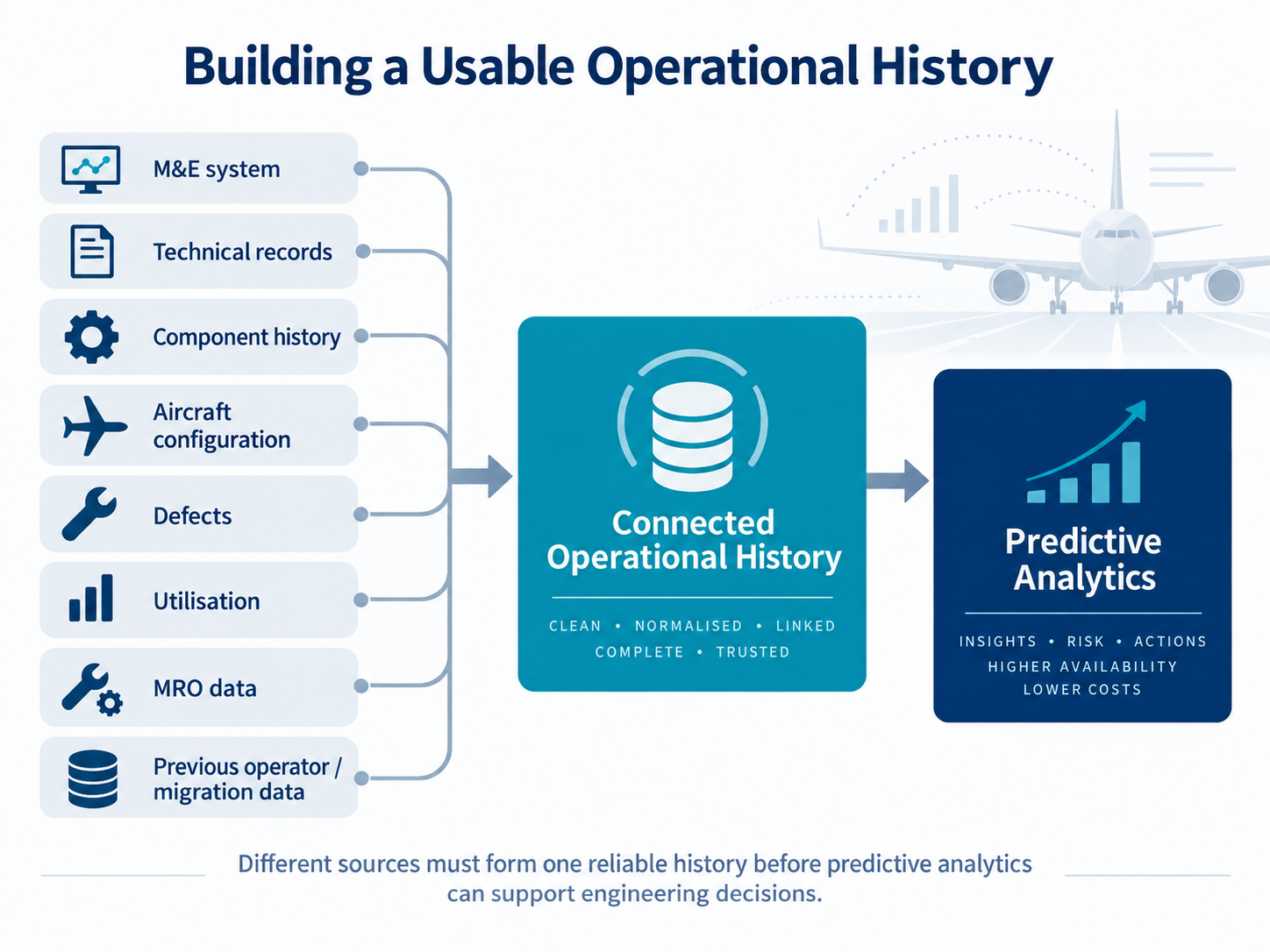
Why Aircraft Maintenance History Is Not Automatically Ready for Predictive Analytics
Most airlines have years, sometimes decades, of valuable maintenance and engineering information. That does not mean those histories are immediately ready for predictive use.
Operational information accumulates over time through different M&E systems, aircraft acquisitions, migrations, maintenance organisations and engineering processes. Naming conventions change. Aircraft move between operators. Components move between aircraft. Defects may be recorded differently across fleets or time periods, while historical records can contain gaps, inconsistencies or information captured under processes that have since changed.
Engineers have learned how to work with that reality. They know when a record needs another check, which source normally provides the most reliable context, and when an unusual entry should be investigated before it is used.
An analytical model does not possess that practical experience unless the relevant context is available in the information being analysed.
Preparing historical aircraft maintenance data for predictive use is therefore more than a data-cleaning exercise. The objective is not simply to remove incorrect values or standardise fields. It is to preserve enough engineering context to understand what an event represents, how it relates to the aircraft and what happened before and after it.
That context is what turns a collection of historical records into an operational history that can support meaningful analysis.
Predictive Insights Need Aircraft and Component Context
Imagine an analytical model identifies a higher probability of an unscheduled component removal on a particular part of the fleet.
For Engineering, that signal is useful, but it is only the beginning of the investigation.
Which aircraft are affected? Are they operating with the same configuration? Are the same part numbers installed? Have similar defects appeared previously? What maintenance actions were taken? Was the component replaced or repaired? Did the issue return afterwards? Have the affected aircraft accumulated comparable hours or cycles?
The answer to those questions determines whether an apparent pattern is operationally meaningful.
Without that context, a prediction can create another investigation rather than supporting a faster decision. Engineers still have to move between systems, reconstruct component histories, and verify whether the aircraft being compared are actually comparable.
The objective of predictive maintenance should therefore not be to produce more alerts. It should be to provide earlier insight while allowing Engineering to move efficiently from a developing signal into the aircraft, component, and maintenance information needed to understand it.
The value of prediction is not simply knowing that something might happen. It is having enough context to determine whether the signal matters and what should be investigated next.
Predictive Readiness Is Built During Daily Operations
Becoming predictive does not begin when an organisation purchases an analytics platform or starts an AI project. Much of the foundation is created years earlier through the way engineering information is recorded and maintained during normal operations.
Every defect recorded today becomes part of tomorrow’s maintenance history. Every component replacement adds another piece of information about component behaviour. Every maintenance action creates evidence about what was done in response to a technical issue. Every utilisation update provides context for understanding how an aircraft and its components have been operated.
When those individual events remain connected over time, they form a usable operational history. When they become fragmented across systems, spreadsheets and organisations, that history has to be reconstructed before it can be used confidently. Engineers can follow a defect through subsequent maintenance actions, relate component behaviour to utilisation and configuration, and compare similar events across the fleet with greater confidence.
When the same information becomes fragmented across M&E systems, spreadsheets, external maintenance organisations or historical migrations, much of that context has to be reconstructed before it can support reliable analysis.
Predictive Readiness is therefore not a separate digital initiative. It develops through the way operational information is created, connected and maintained every day.
That also means organisations can improve predictive readiness before deploying a predictive model. Better component histories, more consistent defect information, stronger configuration control and fewer breaks between maintenance events all improve the quality of the operational foundation on which future analytics will depend.
Prediction Does Not Remove the Engineer from the Decision
This distinction matters particularly in aviation, where engineering decisions sit within an environment shaped by safety, airworthiness and operational consequences. Engineers need to understand the basis for the decisions they make.
Predictive analytics can support that process by identifying developing patterns, directing attention toward areas of potential risk and highlighting relationships that would be difficult to recognise manually across large amounts of maintenance data. This broader relationship between aircraft health data, analysis and engineering decision-making is also reflected in FAA guidance on Integrated Aircraft Health Management.
It does not remove the need for engineering judgement.
A predictive indication still has to be interpreted in the context of the aircraft, its configuration, maintenance history and current operational condition. The same analytical signal may have different implications depending on the part number installed, previous maintenance actions, utilisation pattern or known fleet behaviour.
Better predictive capability should therefore give engineers more time and better information with which to make those judgements. It should help them investigate earlier and focus their attention where it is most useful, rather than asking them to accept an output they cannot trace back to the underlying aircraft information.
Technical accuracy alone is not enough. Engineers also need to understand and validate the operational information supporting the prediction. If they cannot establish where the signal came from or how it relates to the aircraft, they are unlikely to rely on it when the decision matters.
From Reliability Intelligence to Predictive Readiness
At EXSYN, we see predictive maintenance as part of a broader progression in engineering capability.
It begins with a Reliable Data Foundation: operational information that is sufficiently complete, connected, and consistent to support engineering work without repeated reconciliation of the same underlying records.
That foundation also supports Compliance Confidence, helping CAMO and Engineering understand and demonstrate aircraft configuration, continuing airworthiness status and the evidence behind compliance decisions.
With reliable historical information available, engineering teams can develop Reliability Intelligence through more consistent reliability reporting and analysis. Reporting and analysis can move beyond assembling the data required to describe what happened and toward identifying patterns, recurring defects, performance variances and areas that require further investigation.
Only then does the next question become genuinely useful:
What is likely to happen next?
That is Predictive Readiness.
Within the Operational Confidence Journey, these stages build on one another because predictive analysis depends on the history created by the engineering processes that came before it. Aviation Data Continuity supports that progression by preserving the operational information and context required as aircraft change, components move, maintenance is performed, and data passes between systems and organisations.
EXSYN applications support different parts of that lifecycle. Reliability Analysis helps engineering teams identify patterns and investigate fleet performance, while Engine Health Monitor and AOG Risk Monitor support earlier visibility of developing operational risks. The wider EXSYN platform helps maintain the continuity of the information those capabilities depend upon.
Predictive maintenance is therefore not the starting point of the digital engineering journey. It is one of the outcomes of getting the operational foundation right. The same operational foundation also determines how effectively organisations can move toward AI-assisted engineering decisions.
Before an engineering organisation can confidently ask what is likely to happen next, it needs an operational history that reliably explains what happened before.
Frequently Asked Questions About Predictive Maintenance Readiness
-
Predictive maintenance can draw on maintenance events, defect history, aircraft utilisation, component installation and removal history, aircraft configuration, previous maintenance actions and other operational information. The usefulness of those inputs depends not only on their availability but also on their completeness, consistency and connection to the aircraft or component being analysed.
-
Predictive analysis relies on historical information to identify recurring behaviour and developing patterns. If maintenance events, component histories or aircraft configuration are incomplete or inconsistent, the resulting prediction can be more difficult for Engineering to interpret and validate.
-
Predictive Readiness describes the operational capability to use historical and current engineering information reliably for forecasting, earlier risk identification and predictive analysis. It depends on the quality and continuity of the underlying aircraft and maintenance information, not only on the analytical technology being used.
-
Predictive analytics can help identify developing risks and direct engineering attention toward patterns that deserve investigation. The resulting indication still needs to be interpreted within the aircraft’s configuration, maintenance history and operational context. Engineering responsibility therefore remains with the organisation making the decision.