
Why Engineers Spend More Time Validating Than Analysing
Engineering Expertise Should Be Spent Solving Problems
Across every airline, MRO and CAMO organisation, engineering teams perform highly specialised work that keeps aircraft safe, compliant and operational. Reliability Engineers investigate recurring defects and operational trends, Maintenance Planners balance aircraft availability with maintenance requirements, Technical Records teams safeguard the integrity of aircraft history, while CAMO teams ensure continuing airworthiness. Together, their expertise directly influences fleet reliability, operational performance and safety.
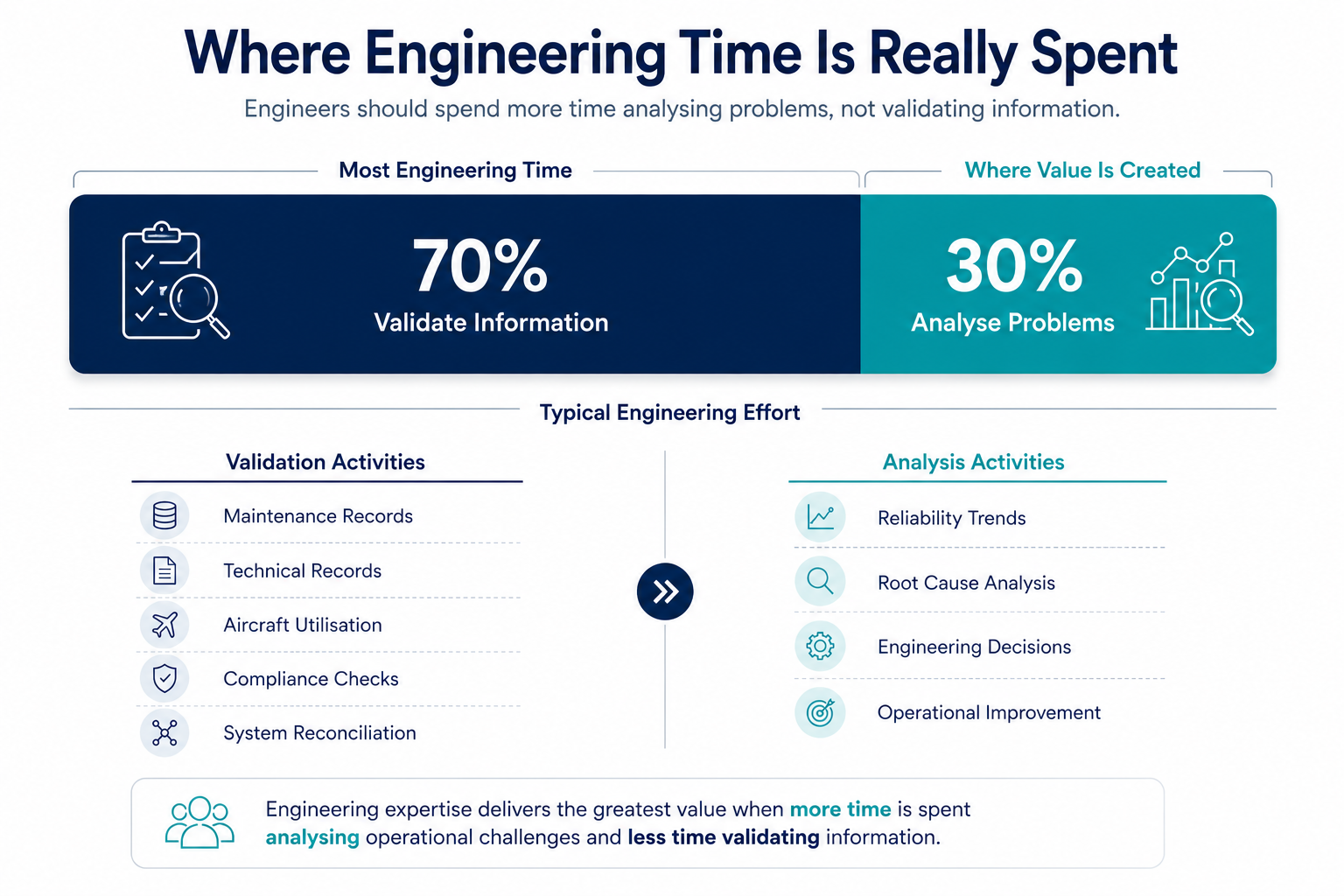
Yet in many organisations, an increasing proportion of that expertise is devoted to validating operational information before meaningful engineering analysis can begin. Engineers often spend valuable time confirming that maintenance records, aircraft utilisation, configuration data and compliance information are complete and consistent before they can confidently investigate a problem or make an operational decision.
The Analysis Often Starts Much Later Than People Think
Consider a typical monthly reliability review. Most people assume the engineering work begins once the necessary operational data has been collected. In practice, that is often the point at which the most valuable work can finally begin.
Before engineers can identify trends, investigate recurring defects or assess fleet performance, they have already spent considerable time preparing and validating the operational information behind the analysis. Maintenance records are exported, aircraft utilisation is retrieved, component removals are verified, technical records are checked, maintenance findings are reconciled, and Airworthiness Directives are confirmed. Differences between operational systems are investigated until engineers are confident the information is complete and consistent.
Only then can meaningful engineering analysis begin. The report itself may require only a small proportion of the total effort, while the majority of the time has already been invested in establishing confidence in the underlying operational information.
Validation Is Essential
Validation is a fundamental part of aviation engineering. Safe operations, regulatory compliance and sound engineering decisions all depend on accurate and reliable operational information. Engineers are responsible for ensuring maintenance activities are correctly planned, continuing airworthiness can be demonstrated, aircraft history is complete, and reliability trends accurately reflect operational reality.
The challenge is not validation itself, but the repeated validation of the same operational information because confidence has not been established earlier in the process. When engineers repeatedly verify information that should already be reliable, valuable engineering capacity is diverted away from analysis, investigation, and operational improvement.
Why Validation Becomes Part of Daily Operations
Most organisations do not deliberately create inefficient engineering processes. They evolve in response to operational needs, regulatory requirements and immediate business priorities.
As systems are introduced, departments establish their own ways of working, additional reports are created, spreadsheets fill information gaps, Power BI dashboards provide local visibility and manual workarounds address specific operational challenges. Each of these decisions delivers value in its own context.
Over time, however, these independent improvements can create an environment where engineers routinely spend time confirming operational information before they can confidently use it. What began as practical solutions gradually becomes embedded in daily operations and is eventually accepted as simply "the way we work."
The Hidden Cost
The impact extends well beyond reporting. When engineering teams spend more time validating information than analysing it, the effects are felt across daily operations. Reliability investigations take longer, maintenance planning becomes less efficient, aircraft transitions require additional effort, compliance activities consume more engineering capacity, and operational decisions are delayed while confidence in the underlying information is re-established.
The greatest cost, however, is not measured in hours spent preparing reports. It is the engineering expertise that cannot be applied elsewhere. Every hour spent validating operational information is an hour that could have been used to reduce recurring defects, improve dispatch reliability, optimise maintenance programmes or investigate opportunities to improve fleet performance.
What Mature Organisations Do Differently
Mature engineering organisations do not wait until reporting begins to establish confidence in their operational information. Confidence is built and maintained as part of everyday engineering processes, so that maintenance records, technical records, aircraft configuration, compliance information and reliability data remain aligned as operations evolve.
As a result, engineers spend less time validating information before each analysis and more time applying their expertise where it delivers the greatest operational value. Their focus shifts towards improving operational performance, reducing operational risk, increasing fleet reliability, and supporting better engineering decisions.
Operational Confidence Frees Engineering Expertise
Engineering productivity is often associated with automation, but there is another opportunity that receives far less attention: reducing the manual effort required before meaningful engineering work can begin.
Operational confidence makes that possible. When engineers can rely on the operational information available to them, they spend less time validating maintenance records, reconciling information across systems and preparing data for analysis. More of their expertise can be applied to investigating technical issues, improving reliability and supporting operational decision-making.
The result is not simply greater efficiency. It is an engineering organisation where specialist knowledge is applied to solving operational challenges rather than preparing information for others to use.
Building an Environment Where Engineers Can Focus on Engineering
At EXSYN, we believe engineering expertise delivers the greatest value when it is applied to understanding operational challenges, improving reliability and supporting better engineering decisions. That is why our approach is centred on Aviation Data Continuity, ensuring operational information remains connected, consistent and reliable throughout the aircraft lifecycle.
With reliable operational information available from the outset, maintenance planning becomes more efficient, compliance is easier to demonstrate, reliability reporting becomes more dependable and engineering analytics deliver greater value. Most importantly, engineers gain more time to focus on improving the safety, reliability and performance of the aircraft they support.
Creating that environment is ultimately what operational confidence is about: enabling engineering teams to spend less time preparing information and more time applying their expertise where it makes the greatest difference.