
For CAMO and Airworthiness Engineering teams, Airworthiness Directive control depends on maintaining a clear relationship between regulatory information, aircraft configuration, and the records held in the operator’s M&E environment.
One practical control point is particularly useful: an AD appears relevant based on aircraft or component effectivity, yet the corresponding initialised or tracked record cannot be identified where Engineering expects to find it in the M&E system. That difference deserves attention.
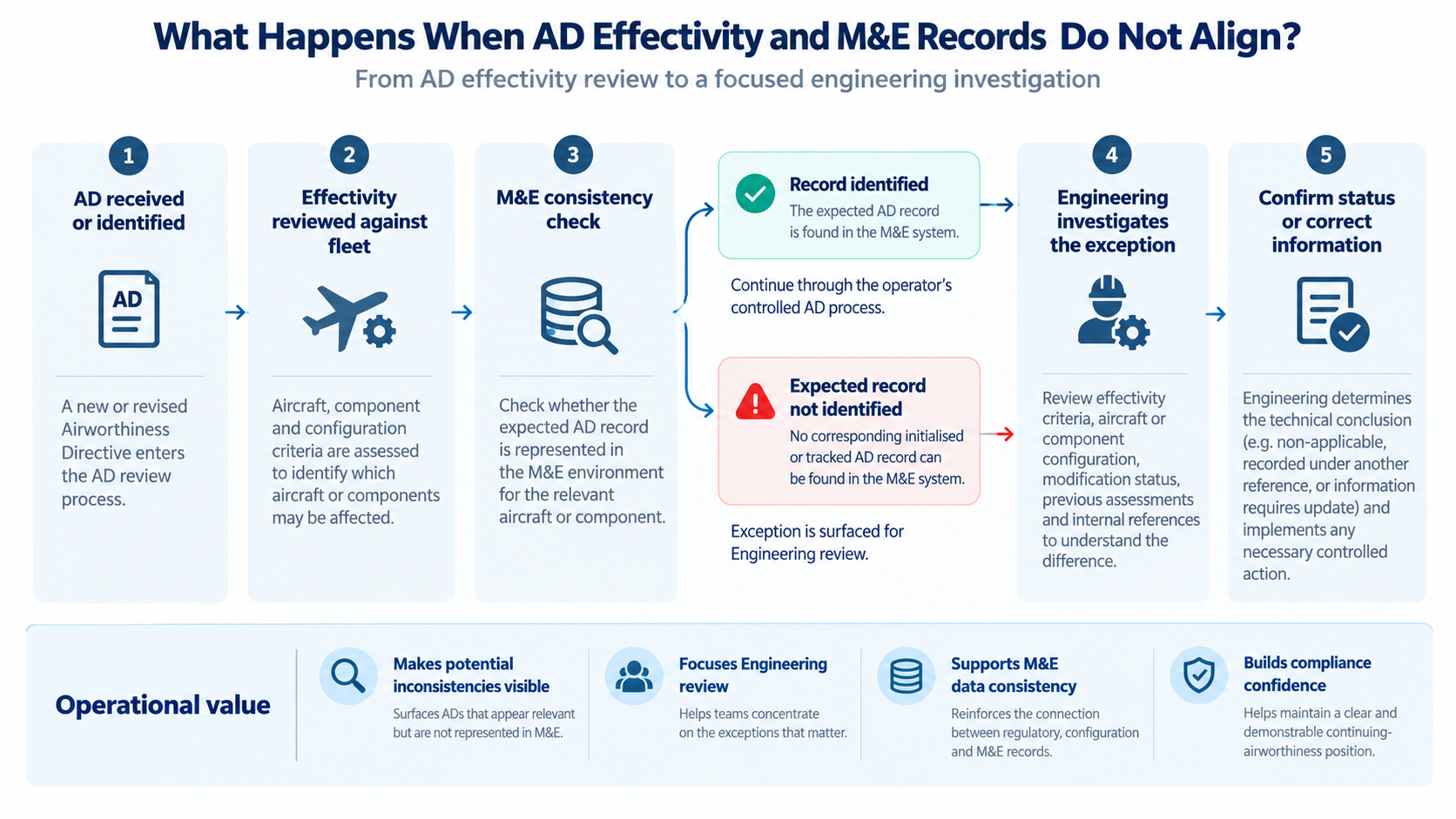
It is an exception for Engineering to investigate and understand: does the aircraft configuration explain the difference, has the directive already been assessed under another internal reference, or is information in the controlled environment incomplete?
This type of finding provides a useful example of how CAMO teams can strengthen daily airworthiness control by making discrepancies visible before they become part of a wider investigation.
The Control Point: Effectivity Says Review, M&E Does Not Show the Expected Record
Airworthiness Directive management involves several connected layers of information.
The authority publication defines the requirement and its effectivity. Aircraft and component configuration provide the technical context. The operator’s M&E environment contains the internal assessment, status, and records used to manage the directive through the continuing-airworthiness process. Those layers usually align.
An exception appears when the external information indicates that an AD falls within a relevant aircraft or component scope, while the expected internal AD record cannot be identified.
The finding can be expressed as a simple control question: If this directive appears relevant based on effectivity, where is it represented in the operator’s controlled M&E environment?
Surfacing that question gives Engineering a specific starting point for review.
Effectivity Is the Starting Point
AD applicability can depend on considerably more than aircraft type.
Depending on the directive, Engineering may need to consider:
manufacturer serial number;
installed component;
part number;
serial number;
modification status;
previous Service Bulletin incorporation;
aircraft or component configuration;
other technical conditions defined in the directive.
Effectivity therefore identifies the population that deserves consideration. Engineering then applies the operator’s actual technical context before reaching an applicability conclusion.
This distinction matters when an expected M&E record cannot be found.
A fleet-level comparison may indicate that the directive is relevant to a particular aircraft or component population. A more detailed technical assessment may subsequently show that the installed configuration excludes the asset, that a modification changes the requirement, or that the directive has already been assessed under another reference.
The exception directs attention to the relationship that needs to be confirmed.
For a broader explanation of how effectivity, configuration and regulatory information fit into CAMO operations, see The Modern CAMO: Managing Airworthiness Across Systems, Records and Operations.
What Can Explain the Exception?
An AD that appears relevant externally while no expected internal record is identified can have several explanations.
The aircraft may no longer carry the affected configuration. A component within the specified part-number or serial-number range may have been removed. A modification may have altered applicability. Engineering may already have assessed the directive and recorded the decision using a different internal reference.
Historical records can also play a role, particularly where aircraft or components have moved between operators or systems.
There are also cases where the investigation confirms that information needs to be added, corrected or represented differently in the M&E environment.
The important point is that the difference becomes visible. Engineering can then establish the technical explanation using the directive, aircraft configuration, maintenance history and existing internal assessment records.
The Exception Is a Prompt for Engineering Review
The presence of an exception is not itself the technical conclusion.
Engineering still needs to determine:
which effectivity criterion brought the aircraft or component into scope;
whether the recorded configuration reflects what is actually installed;
whether an affected part has been removed or replaced;
whether a modification or previous action changes applicability;
whether the AD has already been assessed under another reference;
whether the internal record requires correction or completion.
This preserves a clear boundary between automated information comparison and engineering judgement.
Software can bring potentially inconsistent information into view. CAMO and Engineering remain responsible for understanding the technical basis and determining the appropriate controlled action. That distinction is central to using automation effectively in continuing airworthiness.
How the Difference Can Be Surfaced
A fleet with years of operational history can contain large numbers of AD assessments, component movements, configuration changes and engineering records.
Finding one missing or differently represented relationship manually can therefore be difficult, particularly when most of the underlying records are already correct.
Consistency and airworthiness checks can compare relevant fleet, configuration and M&E information and bring selected discrepancies forward for review.
In this scenario, the value of the check is specific: a directive appears relevant from an effectivity perspective, but the expected internal representation has not been identified.
The check does not need to resolve the technical question. It needs to make the question visible to the engineer who can resolve it.
This allows the CAMO team to focus its attention on identified exceptions rather than discovering the same difference indirectly during another engineering activity.
Keeping the M&E System at the Centre
The M&E system remains the operator’s controlled operational environment for maintenance and continuing-airworthiness information. Checks around regulatory, configuration and M&E information therefore support the existing environment rather than creating a parallel airworthiness record.
If an exception is surfaced, the engineering investigation returns to the relevant technical sources and the controlled M&E record.
Where the existing assessment correctly explains the difference, Engineering confirms the technical position.
Where information needs to be changed, the appropriate update is made through the operator’s established controlled process.
This relationship is important because aircraft status cannot be understood from external regulatory information alone. It depends on the connection between the requirement, the aircraft’s actual configuration and the operator’s engineering assessment.
Where AD Automation Fits in the Wider Process
This proof point represents one control within a broader Airworthiness Directive workflow.
The wider process also includes receiving new and revised directives, reviewing regulatory publications, identifying fleet relevance and preparing information for Engineering assessment.
EXSYN’s AD Automation supports this broader preparation and review process by helping teams work with incoming Airworthiness Directive information more efficiently.
The exception discussed in this article focuses on a different question: whether the expected relationship between effectivity and the operator’s M&E records is visible and consistent.
These activities complement each other.
One helps Engineering work more efficiently with incoming regulatory information. The other helps identify where existing fleet and M&E information deserves additional attention.
In both cases, the engineering decision remains with the operator.
For more detail on the wider AD workflow, see Improving Engineering Productivity as Aviation’s Technical Needs Grow – Insights and Q&A.
Why a Small Difference Can Matter
One missing or differently initialised AD reference may ultimately be straightforward to explain.
Its wider value lies in what the exception reveals about the information relationships behind continuing airworthiness.
Aircraft information changes continuously.
Components move between aircraft. Modifications change configuration. Aircraft enter new fleets. Maintenance histories move between systems. Regulatory information is revised while internal engineering records continue to develop.
These events create opportunities for the external technical picture and the internal operational picture to drift apart.
A consistency check provides a way to test whether those relationships still align.
This becomes particularly valuable during aircraft acquisition, phase-in, M&E system migration or other situations where Engineering needs confidence that historical airworthiness information has been carried forward correctly.
EXSYN customer experience also illustrates the operational relevance of this control. Texel Air has described using EXSYN’s AD-related checks to verify whether the organisation holds the ADs applicable to its aircraft and components, including when evaluating an aircraft for acquisition.
From Daily Control to Compliance Confidence
Differences between effectivity, aircraft configuration and M&E records often become highly visible when an organisation needs to demonstrate the aircraft’s status.
During an audit or Airworthiness Review, CAMO may need to explain why a directive was considered applicable or non-applicable, which aircraft configuration supported that assessment and where the resulting decision is controlled internally.
Finding an unexplained discrepancy at that stage creates additional work when the organisation needs to demonstrate control clearly.
A stronger position is created when these questions are surfaced during normal engineering operations.
CAMO teams can investigate the technical basis, confirm the current position and maintain the appropriate internal record before the same issue appears during an audit, transition or another high-pressure review.
This is closely related to what EXSYN describes as Compliance Confidence: being able to establish and demonstrate the continuing-airworthiness position because the information behind it remains sufficiently connected and controlled.
Read more about why CAMO audit readiness should be built into daily operations.
What This Proof Point Demonstrates
The proof is the visibility of the exception.
A potentially relevant directive appears within the effectivity scope. The expected M&E representation is not immediately identifiable. Engineering receives a specific question to investigate.
From there, the CAMO team applies the technical judgement it already owns: confirm configuration, review applicability, understand the existing record and determine whether any controlled action is required.
The value comes from bringing the discrepancy into view at the point where it can be investigated.
For CAMO teams managing large fleets, changing configurations and years of maintenance history, that visibility provides another control over the information supporting continuing airworthiness.
Further Reading: CAMO & Continuing Airworthiness
If this topic is relevant to your CAMO or Engineering operation, explore these related resources:
The Modern CAMO: Managing Airworthiness Across Systems, Records and Operations
A broader guide to CAMO responsibilities, aircraft configuration, continuing-airworthiness records and regulatory control.
Why CAMO Audit Readiness Should Be Built Into Daily Operations
Explore why stronger daily information control helps reduce the need to reconstruct aircraft status and compliance evidence shortly before an audit.
Improving Engineering Productivity as Aviation’s Technical Needs Grow – Insights and Q&A
See how AD review, OEM revision management, M&E consistency checking and other engineering workflows can reduce repeated information preparation.

Frequently Asked Questions About AD Effectivity and M&E Data Checks
-
It means the relationship between the regulatory information and the operator’s internal records requires review. The explanation may be related to aircraft or component configuration, a previous applicability decision, another internal reference or information that needs to be corrected.
-
No. The finding is an exception for investigation. Engineering still needs to review effectivity, aircraft or component configuration, previous assessments and internal records before reaching a technical conclusion.
-
The operator’s CAMO or Engineering organisation determines applicability according to the directive, aircraft or component configuration and the operator’s approved processes. Automated tools can support the preparation and comparison of information, while the final technical decision remains with Engineering.