
An aircraft maintenance programme evolves throughout the operational life of a fleet. Aircraft accumulate flight hours and cycles, operating conditions change, modifications are introduced, and maintenance organisations develop a better understanding of how particular systems and components behave in service.
For the engineers responsible for maintaining the Aircraft Maintenance Programme (AMP), this creates an ongoing requirement to assess whether scheduled maintenance tasks remain appropriate for the aircraft and the way they are operated. In-service experience, scheduled maintenance findings, repetitive defects and unscheduled maintenance activity all contribute to that assessment.
Much of this information is already collected through the airline's reliability programme. However, its use in maintenance programme development requires a different level of analysis from that normally presented in a monthly fleet reliability report.

Maintenance Programme Compliance and Effectiveness
Within a CAMO, considerable attention is given to ensuring that maintenance requirements are correctly established, scheduled and accomplished within the applicable limits. Maintenance programme effectiveness introduces a further technical consideration: whether the content and periodicity of those tasks remain appropriate in light of operational experience.
An inspection may have been accomplished consistently at its prescribed interval for several years. During that time, it may have produced regular findings, very few findings or evidence of deterioration that requires closer attention. Each of these outcomes provides information that can contribute to the next maintenance programme review.
For maintenance programmes based on MSG-3 logic, EASA guidance identifies monitoring task effectiveness and the adequacy of maintenance intervals as objectives of the reliability programme. Periodic AMP reviews should also consider in-service experience, changes in operating conditions, modifications, repairs and updated maintenance instructions from the relevant design approval holders.
The ability to retrieve and assess this evidence is therefore an important part of continuing airworthiness management.
What Scheduled Maintenance Findings Can Reveal
Scheduled maintenance findings provide one of the most direct sources of evidence when assessing maintenance programme effectiveness.
Consider an inspection task that has been performed across a fleet over several maintenance cycles. Its findings history may indicate whether deterioration is regularly being detected, whether findings are concentrated on particular aircraft, or whether the nature of the findings has changed as the fleet has aged.
To interpret that history, Engineering needs to understand how often the task has been accomplished, how findings have been recorded, the applicable task interval and the operating history of the aircraft involved. A finding count on its own can be misleading, particularly when comparing tasks with different accomplishment frequencies.
A task performed several hundred times across a fleet would naturally be expected to generate a different volume of findings from one performed only a few times. Comparing findings against task accomplishments provides a more meaningful starting point, provided the underlying records and finding classifications are consistent.
Repeated nil findings can also be relevant to a review, although their significance depends on the purpose of the task, the associated failure mode, the available sample size and any applicable mandatory requirements.
Looking at Scheduled and Unscheduled Maintenance Together
Scheduled maintenance findings represent only part of the aircraft's in-service experience. Defects raised between scheduled maintenance events can provide additional evidence about system and component behaviour.
An increase in unscheduled maintenance activity within a particular ATA chapter, for example, may justify examining the scheduled tasks associated with that system. Engineering may need to consider whether the events are related to the same failure mode, whether recent maintenance activity is relevant, or whether the existing task addresses the condition observed in service.
The relationship requires careful interpretation. A rise in hydraulic system defects does not necessarily indicate that the hydraulic system's scheduled maintenance tasks are ineffective. The events may instead relate to individual component failures, configuration differences, operating conditions or maintenance practices.
Reviewing scheduled maintenance findings alongside unscheduled work allows engineers to identify areas requiring closer investigation and establish whether there is sufficient evidence to consider a maintenance programme change.
Component reliability information can provide further context, particularly where unscheduled removals, repeated component failures or changes in MTBUR are associated with the systems under review.
Building the Evidence for Maintenance Interval Reviews
Maintenance intervals are established with reference to applicable maintenance requirements, task objectives and the technical characteristics of the aircraft. As operational experience develops, some tasks may warrant a review of their existing periodicity.
A task that consistently produces few findings may be considered for further assessment. Conversely, repeated significant findings or evidence of deterioration between scheduled maintenance events may indicate that the existing interval deserves closer examination.
Preparing the technical justification for such a review can involve considerable work. Engineers may need to retrieve task accomplishment histories, maintenance findings, defect records, aircraft utilisation and configuration information covering several years of operation.
The quality and completeness of those records are particularly important when the fleet includes aircraft with different ages, modification statuses or operating histories. A finding rate calculated across the entire fleet may conceal differences between groups of aircraft that are relevant to the assessment.
Any proposed interval escalation or de-escalation must be evaluated against the applicable technical and regulatory requirements. Mandatory limitations and requirements cannot be altered simply on the basis of favourable reliability statistics. Programme amendments remain subject to the operator's approved procedures and the applicable approval requirements.
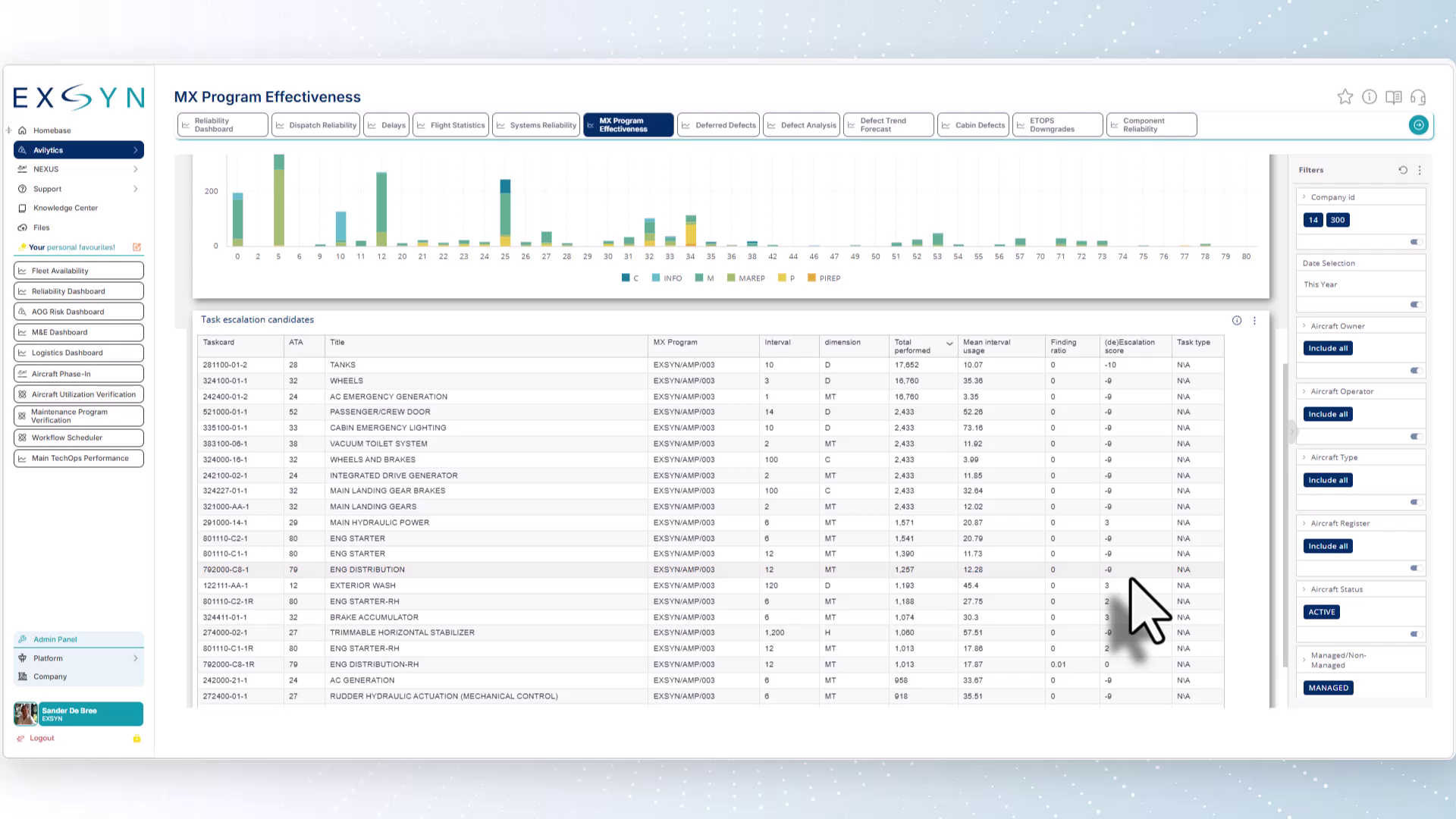
Task-level analysis supports the identification of maintenance intervals that may warrant further engineering assessment.
Using Reliability Analysis to Support the AMP Review
Reliability Analysis can bring several of the datasets required for maintenance programme review into a common analytical environment. Rather than examining task accomplishment histories, findings and unscheduled maintenance activity through separate reports, engineers can review these areas alongside one another.
A maintenance programme effectiveness view may include the distribution of scheduled tasks across ATA chapters, the distribution of task intervals, task-level findings information and the volume of unscheduled maintenance work associated with different aircraft systems.
These views allow the review to begin at programme or fleet level before narrowing down to areas that warrant individual assessment. An ATA chapter generating a considerable amount of unscheduled maintenance activity can be examined alongside the relevant scheduled task population. Individual tasks with unusual findings ratios can then be identified for further engineering review.
The analytical environment supports the collection and interpretation of evidence. Establishing the relationship between a maintenance task and a particular failure mode, assessing the technical significance of findings and determining whether an AMP amendment is justified remain engineering responsibilities.
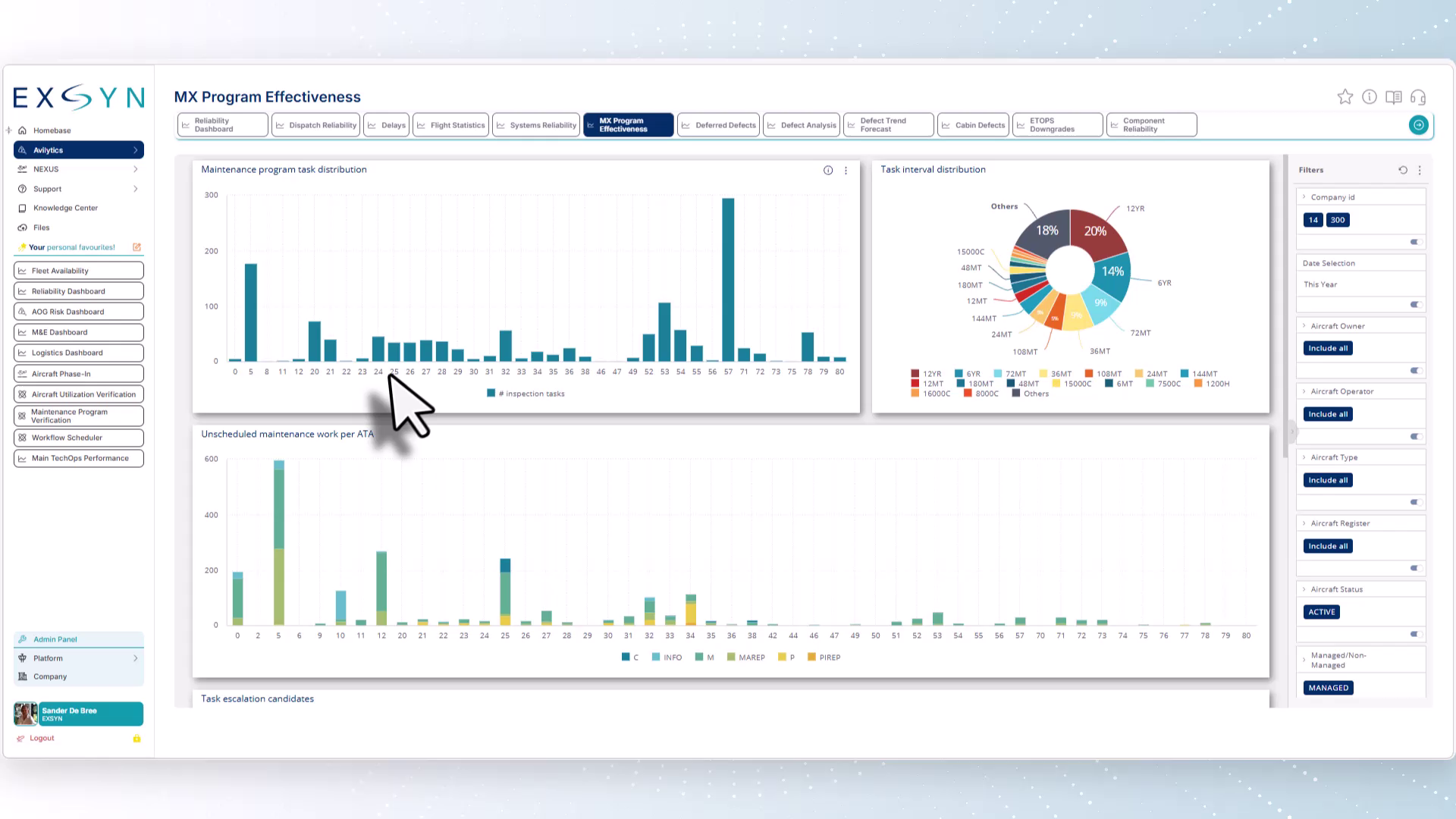
Maintenance programme effectiveness analysis combining scheduled task distribution, task intervals and unscheduled maintenance activity by ATA chapter to support periodic AMP reviews.
Following the Effect of Corrective Actions
The effectiveness of the reliability programme also depends on what happens after an engineering action has been implemented. An operator may introduce a modification, revise a maintenance procedure, conduct a fleet inspection or amend a maintenance task following a reliability investigation.
Subsequent reliability reviews need to establish whether the expected improvement has materialised. This may involve monitoring defect rates, unscheduled component removals, repeat findings or other measures over an appropriate period of operation.
The comparison needs to account for changes in utilisation, fleet composition and aircraft configuration, particularly when evaluating corrective actions across several aircraft. A reduction in reported defects during a period of lower utilisation, for instance, may require a different interpretation from a comparable reduction under stable operating conditions.
Maintaining a consistent history of operational events, maintenance findings and engineering actions makes these assessments easier to conduct and provides a more traceable basis for future reliability and maintenance programme reviews.
Connecting Reliability Engineering and CAMO
Reliability Engineering and Maintenance Programme Engineering often work with overlapping information, although their immediate responsibilities may differ.
Reliability Engineers monitor aircraft, system and component performance, investigate adverse trends and assess the results of corrective actions. Maintenance Programme Engineers consider that operational experience alongside scheduled task requirements, manufacturer recommendations and continuing airworthiness obligations.
The ability to review the same underlying operational evidence supports closer coordination between these functions. A reliability investigation may identify an area that warrants maintenance programme assessment, while findings from scheduled maintenance may provide additional context for a developing reliability trend.
This is one of the wider applications of Reliability Intelligence. When defect history, component performance, scheduled maintenance findings and aircraft utilisation are available within a consistent analytical environment, the information collected through the reliability programme can also support the continuing development of the AMP.
Maintenance Programme Effectiveness Within EXSYN Reliability Intelligence
EXSYN's Reliability Analysis App includes a dedicated Maintenance Programme Effectiveness capability, providing analytical views of task distribution, maintenance intervals, findings and unscheduled maintenance activity.
Working alongside the airline's existing M&E system, the application helps engineers identify areas that warrant further investigation, including potential candidates for maintenance interval escalation or de-escalation. It also supports wider reliability analysis across aircraft, ATA chapters, defects, technical delays and component performance.
For CAMO and Reliability Engineering teams preparing an AMP review, having this information readily available can reduce the work involved in assembling the supporting evidence and make it easier to examine how scheduled maintenance requirements relate to actual in-service experience.
The technical justification for programme changes, the assessment of associated risks and the applicable approval processes remain with the responsible organisation.

Frequently Asked Questions About Aircraft Maintenance Programme Effectiveness
-
Maintenance programme effectiveness concerns whether scheduled maintenance tasks continue to fulfil their intended objectives and whether their intervals remain appropriate for the aircraft's operating conditions and in-service experience.
-
A reliability programme provides information on aircraft and system performance, defects, component removals, maintenance findings and corrective actions. This evidence can support periodic maintenance programme reviews and the assessment of potential task changes.
-
Relevant information may include scheduled task accomplishments, maintenance findings, defect history, unscheduled maintenance activity, component removals, aircraft utilisation, configuration and previous corrective actions.
-
Yes. Reliability analysis can help identify tasks that warrant an interval review and provide supporting operational evidence. Any escalation requires an appropriate technical assessment and must follow the applicable maintenance programme procedures and regulatory requirements.
-
Not necessarily. Nil findings must be interpreted in relation to the task's purpose, failure consequences, sample size, operating experience and applicable mandatory requirements. The absence of findings alone is insufficient justification for changing a maintenance interval.