
Latest News & Blog Posts
Featured



Featured
Texel Air has joined the EXSYN community through an enterprise-wide agreement to onboard its entire fleet of aircraft onto EXSYN’s suite of modular aviation data apps.
Together with Aircraft IT, we hosted a live webinar exploring how CAMO and engineering teams strengthen predictive aircraft maintenance through a modular, aviation-native data platform built around real operational workflows.
EXSYN has deployed Predictive Spare Parts Planning at Volotea, enabling long-term, data-driven forecasting of material demand. By combining maintenance program data with historical unscheduled events, Volotea can optimise procurement, reduce AOG risk, and improve fleet reliability. EXSYN demonstrates how predictive aviation data directly drives cost efficiency and operational resilience.
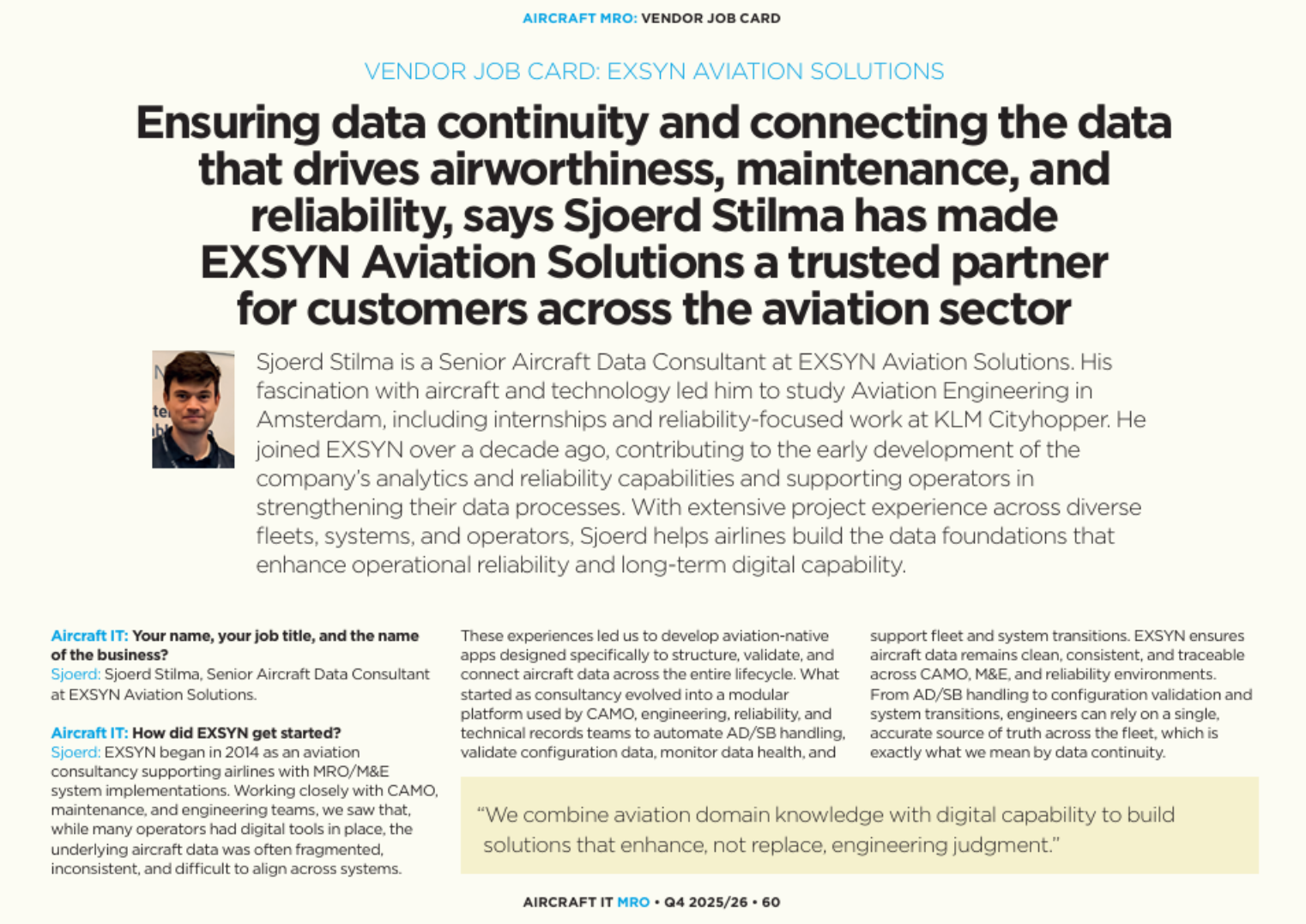
Sjoerd Stilma is a Senior Aircraft Data Consultant at EXSYN Aviation Solutions. His fascination with aircraft and technology led him to study Aviation Engineering in Amsterdam, including internships and reliability-focused work at KLM Cityhopper. He joined EXSYN over a decade ago, contributing to the early development of the company’s analytics and reliability capabilities and supporting operators in strengthening their data processes.
OEM revisions and Airworthiness Directives create recurring preparation for CAMO and Engineering teams. This article shows how structured revision review and AD monitoring can bring relevant changes to engineers with the context needed for controlled action.
Continuing airworthiness depends on much more than completing maintenance on time. This complete CAMO guide explains Part-CAMO responsibilities, maintenance programmes, AD and SB management, aircraft configuration, technical records, Airworthiness Reviews, MRO interfaces and the digital systems supporting modern continuing airworthiness management.
As aviation's technical workload grows, engineering and maintenance teams need to make better use of existing capacity. Explore the key insights and audience Q&A from EXSYN's latest webinar on OEM revisions, AD automation, airworthiness checks and maintenance analytics.
Updating hundreds of AMOS work templates? Learn how to prepare, validate and load bulk revisions while keeping each one linked to its original template.