
Blog
Insights, updates, and best practices for Aviation Maintenance & Engineering
CAMO Data Continuity and Predictive Maintenance: Foundations for Stable Aviation Operations
EXSYN & Aircraft IT Q1 webinar began with a reality that every CAMO and engineering teams recognizes: there is no shortage of aircraft data.
The challenge is fragmentation. Flight logs, maintenance records, configuration data, component tracking, OEM documentation, and authority publications move continuously through multiple systems. Under operational pressure, small inconsistencies enter that flow.

Why Predictive Insight Fails Until Operations Truly Connect
Forward-looking insight is often treated as a tooling problem. When predictions miss, the instinct is to look at models, dashboards, or data science maturity. In practice, the root cause is usually much more fundamental. Predictive insight breaks down when organizations are structured to optimize locally rather than operate coherently.

Predictive Aviation Starts With Reliability
Predictive aviation is most often approached as a data-science exercise. The assumption is straightforward: collect enough data, apply advanced analytics, and maintenance outcomes will become predictable. In practice, this approach is precisely why many predictive initiatives fail to move beyond pilots and proofs of concept.

Data Migration Is Where Data Continuity Is Decided
Data migration is often treated as a technical step in system implementation, but its real impact becomes visible long after go-live. The way maintenance and airworthiness data is structured, validated, and aligned during migration determines whether engineers trust the system or continue to rely on manual checks. This article explores why migration is not just a transfer of data, but the point at which data continuity is either established or lost.
From Data Chaos to Predictive Stability: A Before/After Continuity Scenario
Early in the month the reliability team exports data and MTBUR shifts. No major removals occurred, no procedural changes were made, yet the indicator moves enough to unsettle planning. To get the board package out, analysts rebuild queries in Excel and stitch together extracts from different weeks. The spreadsheet gives a defensible number, but it is disconnected from last month’s lineage, so trend lines lose meaning.

Unblocking MMP/OMP Revisions in AMOS
MMP/OMP revisions can become locked when the Maintenance Program control flag activation_blocker_oprev is set to a non-zero OPREV ID, preventing edits, activation, or progression even if the OPREV is stale. Fix by backing up the affected rows, resetting activation_blocker_oprev to 0 in a transaction, and refreshing the MMP “Operator Maintenance Program” window to clear caches and re-sync the UI.

Why Predictive Projects Fail: The Hidden Role of Data Drift
Predictive initiatives rarely fail with a single obvious mistake. More often, they start strong and then quietly lose credibility. Early results look good, prototypes perform well, and then operations begins to notice gaps. The predictions stop matching what people see on the line. Exceptions grow. Confidence drops.
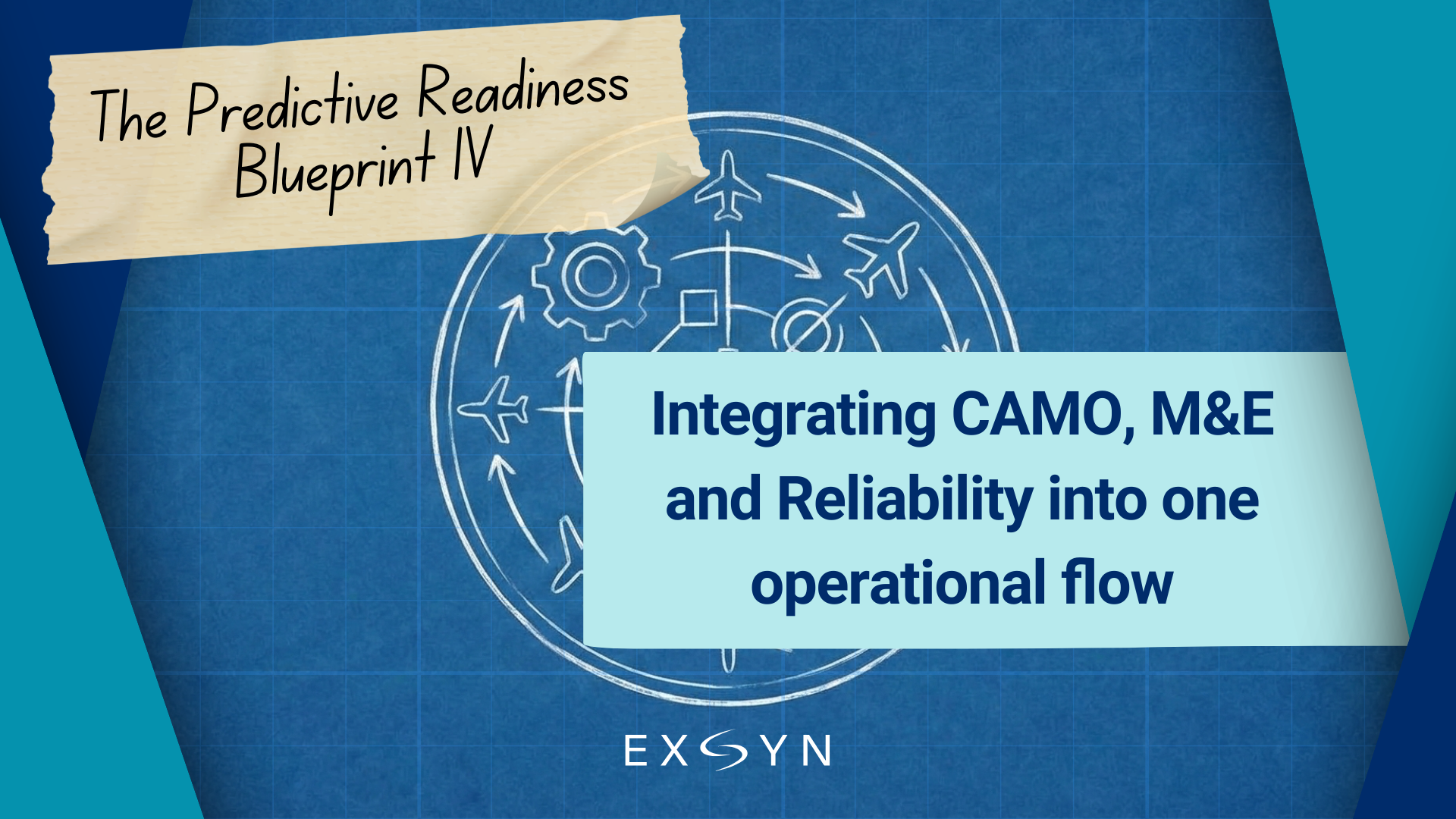
Predictive Readiness Blueprint, Part IV: Integrating CAMO, M&E and Reliability into one operational flow
Predictive efforts stall at handovers. The cure is a single flow: OEM library for documented truth, AD integration for a shared regulatory picture, M&E health checks and airworthiness reviews for validated data. Reliability and engine health then run on leg- and serial-linked signals, refreshed by a scheduler. Result: stable KPIs, cleaner trends, fewer false positives.

Predictive Readiness Blueprint, Part III: The Human Factor in Data-Driven Aviation
Predictive maintenance succeeds only when people believe what the data is telling them. Engineers, reliability analysts, and CAMO staff do not reject models because they dislike innovation. They pause because their lived experience has taught them that small inconsistencies grow into audit findings, deferred defects, and avoidable AOGs.

Predictive Readiness Blueprint, Part II — Why Reliability Must Drive Predictive Aviation
Predictive maturity starts with disciplined reliability data, not telemetry or algorithms. Clean and connected M&E records create the only foundation models can stand on. Without that layer, prediction turns into noise instead of operational intelligence.
The Predictive Readiness Blueprint I - Why Clean, Connected Data is the Real Starting Point
The Predictive Readiness Blueprint Series examines how gaps in OEM documents, M&E data integrity, reliability definitions, and engine-history alignment quietly erode trust across AMOS, TRAX, and analytics environments. It shows how EXSYN’s continuity layer creates the clean, connected, predictive foundation aviation teams rely on.
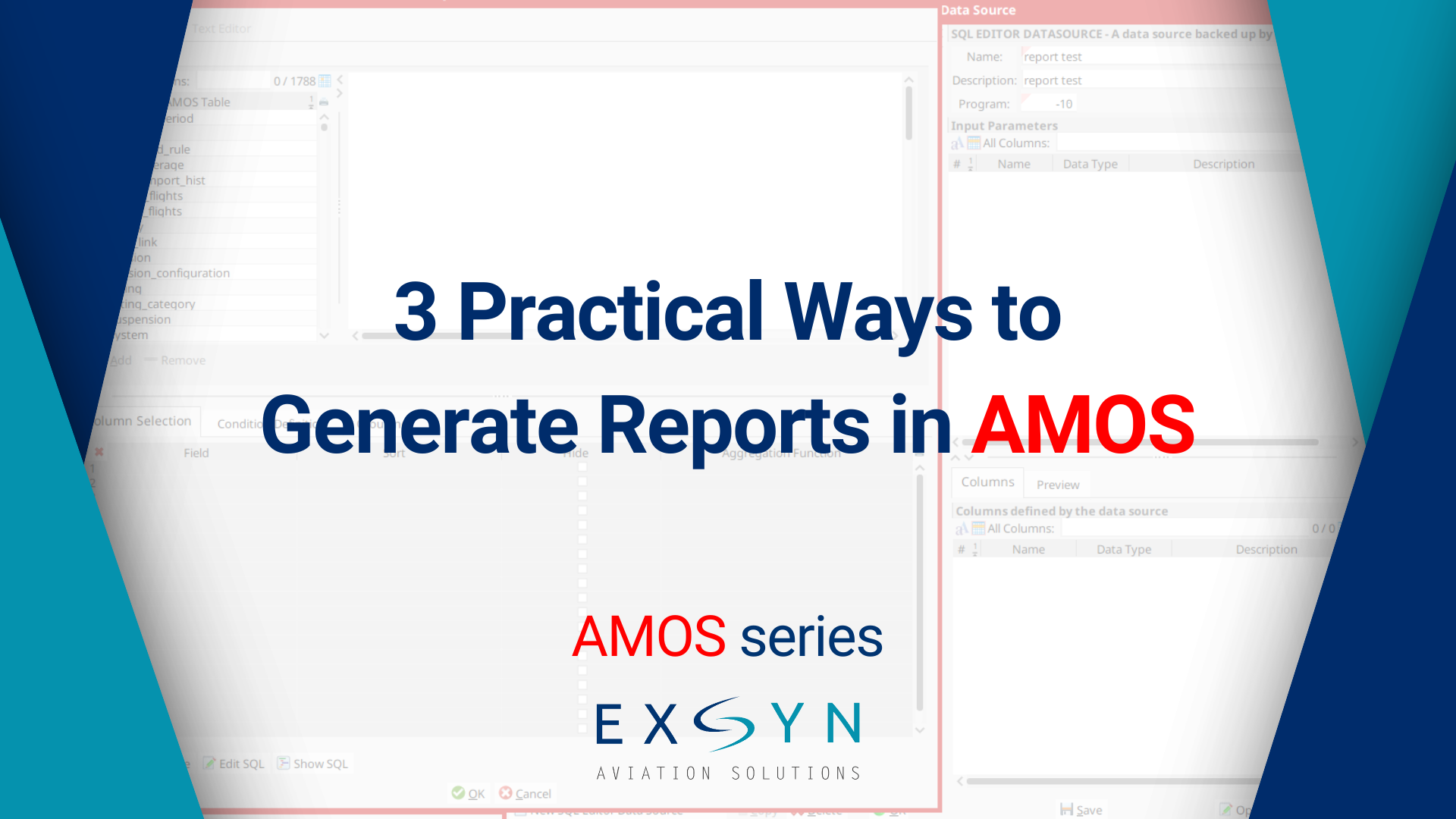
3 Practical Ways to Generate Reports With AMOS
AMOS offers several ways to create, access and automate reports. This practical guide explains how to use APN 966 Report Designer, SQL queries stored in the web-drive and APN 2606 AMOS Scheduler to support different reporting requirements.

Fleet Expansion Creates Data Chaos. Continuity is the Only Scalable Solution
Global fleet expansion exposes critical weaknesses in aviation data continuity. Learn how data friction impacts CAMO, Tech Records, and Reliability, and how EXSYN helps operators scale safely

Data Continuity: What It Looks Like in Practice
What does good data continuity actually look like in day-to-day operations? Everyone is aware of the dangers of fragmented information; the difficulty lies in ensuring that the flow between teams and systems is reliable.
Turn fragmented aircraft data into a trusted, predictive asset: EXSYN’s Modular Approach
For more than a decade, EXSYN has supported airlines, MROs, and lessors with data migration and its two product lines, NEXUS and AVILYTICS. This experience now comes together in a modular setup where each application can be licensed separately. Designed to give operators complete control over their data challenges, one app at a time.
From workarounds to workflows: how trusted data removes friction
Data should support the engineer, not replace them. Plans are still crafted by the people who know the aircraft best, and those plans deliver when the inputs are already trusted.

The Hidden Risks of Disconnected Data
One of the most overlooked effects of fragmented data is the blind spot it creates in day-to-day maintenance. An aircraft can appear fully compliant in one system, while another shows missing entries. Inventory planners may over-order because consumption data isn’t synchronized. EXSYN addresses this challenge by acting as the aviation data continuity layer. We don’t replace existing systems. We make them work together.

From Manual Chaos to Structured Compliance: How to Automate AD/SB Management at Scale
EXSYN’s AD/SB Automation and OEM Library Apps streamline airworthiness compliance by monitoring sources, standardizing data, and integrating directly with MRO/M&E systems. This reduces manual work, improving audit readiness, and ensuring data accuracy
Forecast Failures Are Data Failures: Planning with Confidence
No matter how sophisticated the prediction model or maintenance plan, flawed data leads to flawed outcomes. As we often say, “Your forecasts aren’t broken. Your data is.” Disconnected systems, inconsistent logs, and misaligned component records can silently derail even the best plans.

Maximize the Benefits of Predictive Maintenance in Aircraft Maintenance
The safety, effectiveness, and profitability of airline operations are all significantly impacted by aircraft maintenance. Fundamentally, there is a distinct difference between reactive and proactive aircraft maintenance approaches. Although systematic, the industry has long relied on traditional preventive maintenance techniques, which frequently result in premature maintenance and needless expenses.