Component Repair & Overhaul Management - AMOS Series
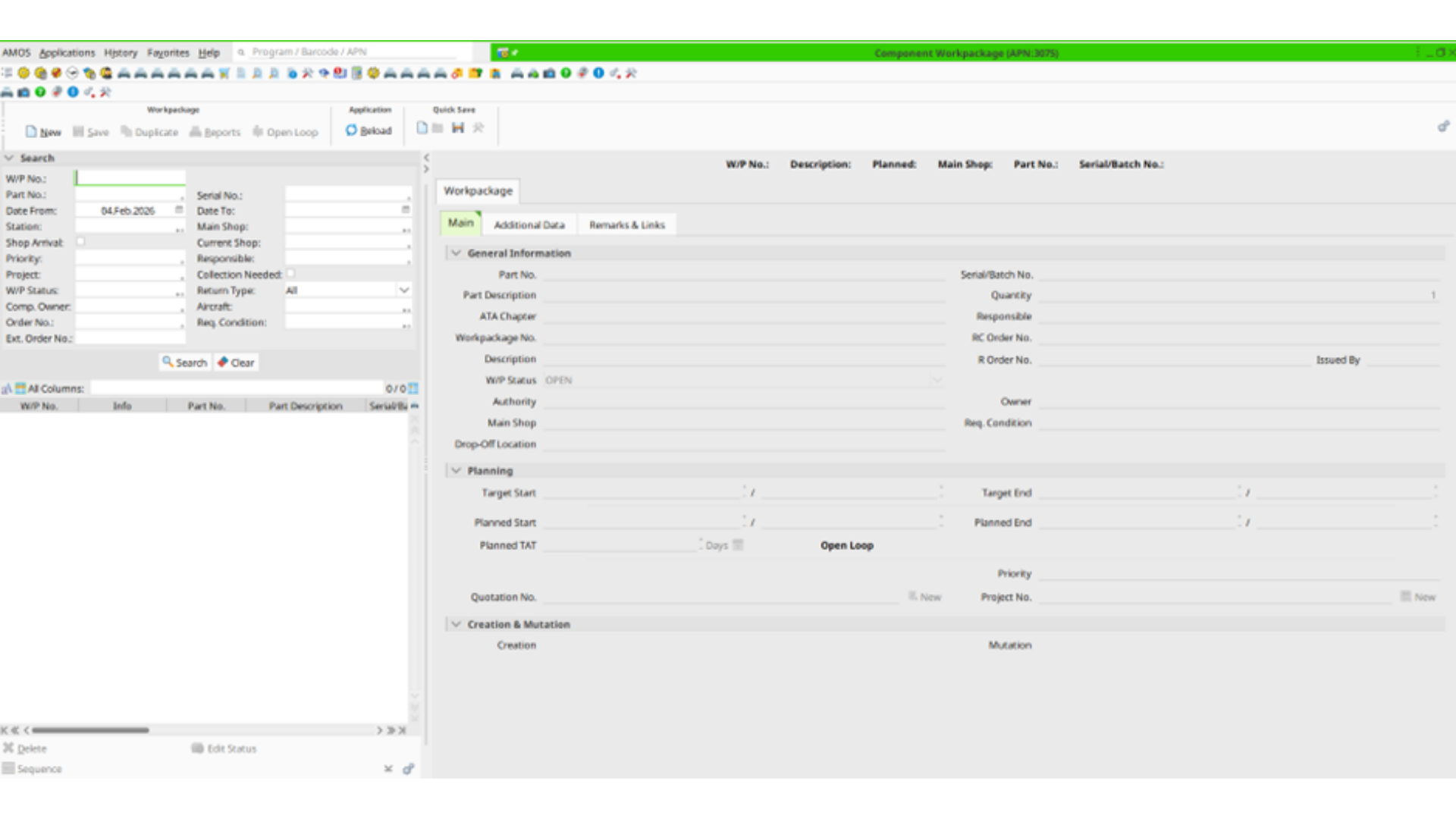
The CROM Module (Component Repair & Overhaul Management) is a new AMOS module (APN 3075), designed to replace the legacy Component Maintenance (CM) APNs.
The former CM functionality had several structural limitations. Effective component repair management in aviation depends on how well the system structures the repair cycle — from requirement definition through to workorder completion and signoff. CROM introduces a modernized framework fully aligned with AMOS worktemplate logic, offering improved flexibility, control, and integration with existing aircraft maintenance processes.
What’s New?
1. Worktemplate-Based Structure
CROM fully utilizes the standard AMOS work template concept.
Two work template types are applicable:
Shopcards (SH)
Executable templates
Used to perform the actual component maintenance work
Component Requirements (COR)
Non-executable templates
Used to define customer or contractual requirements
Linked to Shopcards that execute the required work
This separation enables clearer requirement definition and standardized execution.
2. Work Step Phases (Type “C”)
Instead of defining CM task types, CROM uses Work Step Phases, similar to aircraft maintenance logic.
Phase Type: “C” (Component-specific)
Not mandatory, but recommended for structured process control
This ensures harmonization between aircraft and component maintenance logic.
3. EWI & Digital Signoff Integration
CROM supports:
EWI (Electronic Work Instructions)
When a CMM is linked to a work step.E-Signature functionality
If configured in:
APN 10 → Signoff Settings → Configure Signing Events → Component Workpackage (3075)
This enables digital compliance and process traceability.
Work Execution & Control
Component Workpackage (APN 3075)
All component work is managed in:
APN 3075 – Component Workpackage
(Comparable to APN 58 for aircraft workpackages)
Here, users can:
Collect required Component Requirements (COR)
Assign linked Shopcards
Control execution and signoff
Monitor progress
Each accomplished Shopcard automatically generates a corresponding Workorder, following the same logic as aircraft workpackages.
Capability & Condition Validation
CROM includes built-in validation mechanisms:
Shop Capability Validation
Before execution, AMOS verifies:
Shop capability setup
Validity of capability
Required approval configuration
If the capability is missing or invalid, the work package cannot be released.
Component Condition Validation
Validation is performed against the required component condition defined in APN 18 – Condition
This ensures that maintenance is only performed within approved shop and condition parameters.
Component Planning (New APN 3508)
A new planning functionality has been introduced:
APN 3508 – Component Planning
This module allows planning of upcoming component maintenance:
Based on part requirements
Based on part requests
Even while the component is still installed on the aircraft
This enables proactive component maintenance forecasting and workload preparation.
Key Benefits
Full alignment with AMOS work template philosophy
Clear separation between requirements and execution
Digital process support (EWI + e-signature)
Built-in capability and condition validation
Integrated workorder generation
Improved component maintenance planning
Together, these capabilities improve component repair tracking across aviation maintenance environments, giving shop teams and planners a consistent execution framework.
CROM modernizes component overhaul management and brings it to the same structural level as aircraft maintenance within AMOS.
If you are implementing CROM or optimising your AMOS environment, EXSYN's AMOS consulting team can support configuration, data structuring, and workflow design.